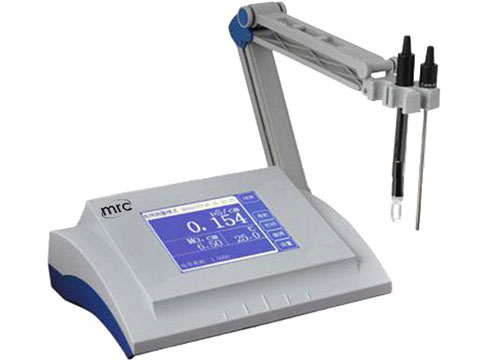
The conductivity meter measures the amount of electric current or conductivity in a solution. A conductivity meter measures the health status of the natural water body.It is very useful in the field of water.
MRC provides a range of professional conductivity meters for various uses.
What is a conductivity meter and when is it used?
In order to check the water conductivity and their speed, a conductivity meter should be used. The meter also reports the correct temperature of the water. Once a conductivity meter is placed in the water, the result can be detected on the monitor.
Conductivity refers to the ability of a substance to conduct electric current. When we talk about the conductivity of water, it is a measure of how well water can conduct electricity.
Water itself is a poor conductor of electricity because it is a covalent compound made up of hydrogen and oxygen atoms, which do not readily allow the flow of electric charges. However, water can contain dissolved substances called electrolytes that increase its conductivity.
When certain substances, such as salts, acids, or bases, are dissolved in water, they break down into ions. These ions are electrically charged particles that can move freely in the water, allowing electric current to flow. The presence of these dissolved ions increases the water's conductivity.
Pure water, without any dissolved ions, has very low conductivity. However, in practical situations, water often contains impurities or naturally occurring minerals that contribute to its conductivity. For example, tap water may contain dissolved minerals like calcium, magnesium, sodium, and others, which enhance its conductivity.
Conductivity is an important parameter in various fields and industries. It is commonly used in water quality testing, environmental monitoring, and industrial processes. By measuring the conductivity of water, we can gain insights into its purity, level of contamination, or the concentration of dissolved substances.
There are several units that measure conductivity:
Conductivity: Conductivity, as mentioned before, refers to the ability of a substance, such as water, to conduct electric current. It is typically measured in units of Siemens per meter (S/m) or milliSiemens per centimeter (mS/cm).
Total Dissolved Solids (TDS): TDS is a measure of the total concentration of dissolved substances in water. It includes both organic and inorganic compounds, such as minerals, salts, metals, and other dissolved particles. TDS is usually expressed in parts per million (ppm) or milligrams per liter (mg/L). TDS can be determined indirectly by measuring conductivity, as there is a correlation between TDS and conductivity in water.
Salt: Salt, in the context of water chemistry, refers to any compound that dissociates into ions in water. Common examples include sodium chloride (table salt), calcium chloride, and potassium chloride. The presence of salts in water increases its conductivity. Salt concentration can be estimated indirectly by measuring conductivity or by measuring TDS.
Hardness: Hardness refers to the concentration of certain dissolved minerals in water, primarily calcium and magnesium ions. These minerals can form scale deposits in pipes and appliances, reducing their efficiency. Hardness is usually expressed in terms of calcium carbonate equivalents, such as parts per million (ppm) or grains per gallon (gpg). Although hardness does not directly correspond to conductivity, it can affect the water's electrical conductivity to some extent.
Resistivity: Resistivity is the inverse of conductivity and measures a substance's ability to resist the flow of electric current. It is often used as a complementary parameter to conductivity. Resistivity is typically measured in units of ohm-meters (Ω·m). The relationship between resistivity (ρ) and conductivity (σ) is given by the equation ρ = 1/σ.
To convert between these different parameters, there are some approximate conversion factors that can be used. However, it's important to note that these conversions are not always precise and can vary depending on the specific water composition and conditions. Calibration with standard solutions and accurate instruments is recommended for precise measurements and conversions.
Applications Of Conductivity Meter
Applications in research and engineering, with common usage in hydroponics, aquaculture, aquaponics, and freshwater systems to monitor the number of nutrients, salts or impurities in the water.