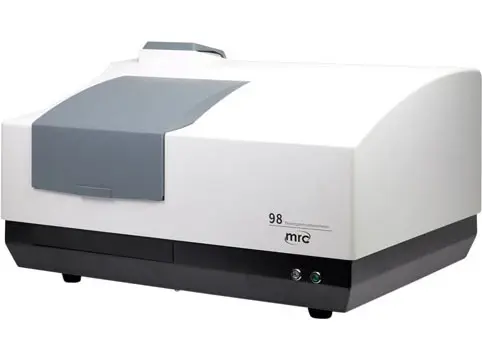
A fluorescent spectrophotometer is an essential tool that measures how substances absorb and emit light.
How Fluorescent Spectrophotometers Work
At the heart of these instruments is the principle of fluorescence: when a molecule absorbs light at one wavelength and emits it at another. A fluorescent spectrophotometer excites the sample with a light source (like a xenon lamp or LED) and then measures the emitted light.
Unlike regular UV-Vis spectrophotometers that only measure absorption, fluorescent spectrophotometers pick up incredibly low concentrations—sometimes down to parts per billion. That’s why they’re considered far more sensitive.
Applications Across Industries
- Biomedical Research – Detecting biomarkers, DNA, and proteins.
- Pharmaceuticals – Drug discovery, stability testing, and purity checks.
- Environmental Testing – Monitoring pollutants in water and air.
- Food and Beverage – Measuring additives, vitamins, and authenticity.
- Academic Research – Teaching and advanced analytical studies.
Wherever precision and trace detection are needed, fluorescence leads the way.
Key Features to Look For
When buying, pay attention to:
- Sensitivity & Detection Limits – How small of a signal can it detect?
- Wavelength Range – Make sure it covers the excitation and emission bands you need.
- Light Sources – Xenon lamps provide broad spectra, while LEDs and lasers offer high intensity at specific ranges.
- Sample Holders – Cuvettes, microplates, and even fiber-optic probes expand usability.
Performance Factors That Matter
Don’t just go by the spec sheet. Real-world performance is shaped by:
- Signal-to-Noise Ratio – Higher means better accuracy.
- Photostability – Can it handle repeated measurements without degradation?
- Reproducibility – Critical for regulated industries.
- Software – Easy-to-use analysis software saves hours of headaches.
- Throughput – If you run high-volume testing, automation support is a must.
Types of Fluorescent Spectrophotometers
- Benchtop Models – Ideal for labs with heavy workloads.
- Portable Models – Great for field testing and environmental monitoring.
- Single-Channel – Simpler and lower cost, but slower.
- Multi-Channel Systems – Faster, capable of simultaneous measurements.
- Hybrid Systems – Often include microplate readers for drug discovery.
Important Buying Considerations
- Budget – Don’t just consider the upfront price. Think long-term costs like lamps, calibration, and software.
- Ease of Use – Will new staff need weeks of training, or can they pick it up quickly?
- Maintenance – Some models need frequent lamp changes; others have longer lifespans.
- Support – A good warranty and responsive service team are invaluable.
Mistakes to Avoid Before Purchasing
- Ignoring Future Needs – Your lab may expand, so think scalability.
- Skipping Demo Testing – Always run real samples before purchase.
- Focusing Only on Price – Cheap now can mean expensive later with repairs.
- Overlooking Compatibility – Ensure it integrates with your current lab systems.
Tips for First-Time Buyers
- Write down your primary applications before shopping.
- Request demonstrations and hands-on trials.
- Ask suppliers for customer references.
- Compare not just price, but support packages.