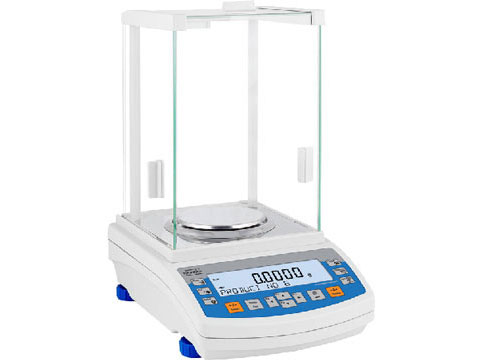
X7 LABORATORY BALANCES FUNCTIONS
AUTOTEST
An automatic diagnostic tool designed to verify the balance’s metrological performance, particularly its repeatability, under actual working conditions. The system automatically evaluates weighing stability and precision, helping to optimize weighing time while saving operator effort.
DOSING
A function that enables precise measurement of materials according to a predefined reference mass and tolerance. The tolerance, expressed as a percentage, defines the acceptable deviation from the target value. Ideal for powders, liquids, and bulk materials, the dosing process is often assisted by a bar graph indicator. In industrial versions, this function can be integrated with automated dosing control systems.
PLUS/MINUS CONTROL
This mode verifies whether the sample’s weight lies within a specified minimum and maximum range. When the result falls between these limits, the weight is deemed correct. A visual bar graph on the display provides instant feedback.
PERCENT WEIGHING
Used to compare the mass of a tested item with a reference standard set as 100%. The balance calculates the result as a percentage relative to that standard. Lighter samples display results below 100%, while heavier samples exceed it. This feature is invaluable for comparative analysis in production and quality control.
PARTS COUNTING
A counting function that determines the number of identical items based on their weight. The user defines or measures the average weight of one piece, after which the system divides the total mass by the single-item mass to calculate quantity. The Automatic Correction of Accuracy feature continually refines this value, compensating for slight variations in individual items. In industrial applications, parts counting can be combined with checkweighing or dosing, and may include audio alerts when the target quantity is reached. Multi-platform systems with varying capacities and resolutions are supported.
PEAK HOLD
Captures and holds the highest weight reading observed during measurement. Commonly used in medical or dynamic applications where it is necessary to record a momentary maximum value.
FORMULATION
Assists in preparing mixtures composed of multiple components. Each ingredient is weighed according to preset tolerances and recorded in the balance’s database. The function ensures accurate control over formulation steps and offers customization for specific workflows.
STATISTICS
Performs automatic recording and analysis of weighing data, providing users with key information such as mean value, standard deviation, range, variance, and maximum/minimum results — essential for statistical process control and documentation.
CHECKWEIGHING
Checks whether a measured sample’s mass falls within predefined upper [HI] and lower [LO] limits, expressed in grams or kilograms. Visual signals (icons or stack lights) display the current weighing status. This mode is often used during packaging, sorting, or inspection processes where tolerance control is critical, e.g., 12,860 g ± 5 g.
IR SENSORS
Infrared sensors enable contact-free operation of selected balance functions such as taring, zeroing, printing, or opening the weighing chamber. This helps maintain cleanliness and prevents contamination — especially valuable in laboratory environments.
UNDER-PAN WEIGHING
Allows weighing of irregularly shaped, oversized, or magnetically active samples suspended beneath the balance. This setup is particularly useful for materials that cannot be placed directly on the weighing pan.
GLP PROCEDURES
Ensures full traceability and documentation of measurement results in accordance with Good Laboratory Practice (GLP) standards. Reports can be generated in either short or extended formats for audit and record-keeping purposes.
ANIMAL WEIGHING
Designed for weighing moving or restless samples, such as live animals. The function averages readings over a user-defined period to determine a stable result, minimizing errors caused by motion.
DENSITY DETERMINATION
Determines the density of solids and liquids using Archimedes’ principle with a dedicated density kit. For solids, measurements are taken first in air and then in a liquid of known density. For liquids, a calibrated sinker is weighed in air and in the test liquid. The system automatically calculates the density while minimizing errors caused by air bubbles or surface tension. Industrial models may use under-pan weighing for large or irregular samples.
AMBIENT CONDITIONS MONITORING
Compatible with the THBR 2.0 system for monitoring environmental parameters such as temperature and humidity, ensuring that weighing conditions remain stable and traceable.
REPLACEABLE UNIT
Allows easy switching between measurement units (e.g., grams, milligrams, carats, etc.) depending on the user’s requirements.
STATISTICAL QUALITY CONTROL
Performs ongoing evaluation of production batches, calculating maximum, minimum, mean values, and standard deviation to maintain statistical control over manufacturing processes.
ALIBI MEMORY
A secure internal memory capable of storing up to 100,000 weighing records automatically. Each entry includes the date, time, result, tare value, operator ID, and product name. When the storage limit is reached, new records overwrite the oldest ones, ensuring continuous logging. Data cannot be deleted manually, guaranteeing traceability. Stored information can be reviewed or printed directly from the database.
MASS FOR TITRATOR
This mode connects the balance to a titrator, automatically transmitting the mass of each dispensed sample. The titrator then signals the balance to proceed to the next measurement, enabling synchronized operation between the two instruments.
WI-FI® CONNECTIVITY
Wireless communication enables safe use of the balance inside laminar flow hoods or fume cupboards, where direct cable connections may not be practical.