With the increase in scientific research, rotary evaporators have become a must-have for laboratories. The equipment which is used in the liquid-vapor conversion is made up of different parts, but the key parts include:
● The condenser.
● The heat bath.
● The rotor.
● The rotating flask.
● The collection flask.
Each part plays an important role in the conversion process, as their names imply. One significant feature is the rotary evaporator's capacity to separate elements without subjecting them to rigorous processes.
Factors that Influence Conversion in a Rotary Evaporator
With the many different yet appealing choices on the market, knowing which evaporator to get could be a hassle. Thankfully, you don't have to go through the stress because these factors would help you streamline your options to just one or two in the end.
1. Air pressure.
Every liquid has a specific boiling point, with alcohol being 78.37°C, but this is only constant when the atmospheric pressure is standard. At lower altitudes, ethanol may have to be heated up to 140°C before it boils. Rotary evaporators allow you to control the pressure in the vessel; thus, you can have liquids heat up quite faster than they would under normal conditions.
1. Speed of rotation.
Rotary evaporators get their name from their mode of operation – rotation. As the flask rotates, the liquid in it is shaken up, which would typically cause irregular motion. Still, the effect of the inertial force in the flask would cause the liquid to rotate simultaneously, thereby stabilizing the movement to a large extent. This is an important process in the separation of fluids. The higher the rotation speed, the faster distillation takes place, so confirm the maximum rotation speed for the evaporator before betting on it.
1. Condensation.
While evaporators are famous for heating liquid and converting it to vapor, they can also be used to reverse the process. To do this, a recirculating chiller may be required (this is gotten separately from the evaporator) to drop the temperature of water almost to freezing point. Knowing that ice cannot be put in the evaporator, the cold water would have to be combined with ethylene glycol to keep it in the liquid state. Most evaporators are built with a system that allows water to pass through the conventional coils where it interacts with the liquid to be converted. Some others use dry ice or liquid nitrogen pumped through cold rods or traps installed in the flask.
1. Vacuum.
Solvents with high boiling points can be separated under lower pressures when placed in a vacuum pump (usually chemical-resistant). This may not be necessary for some samples, but those with relatively high heat sensitivity would require a vacuum for distillation to avoid destroying or altering their nature.
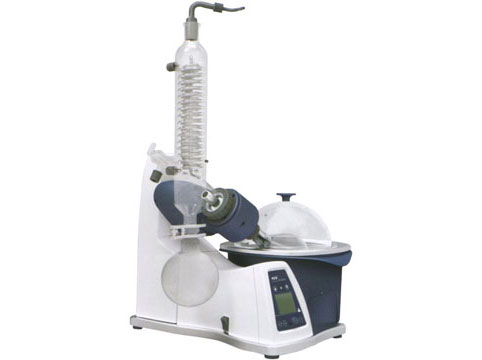
Important Factors to Consider Before the Purchase.
Having identified the major parts and functions of a rotary evaporator there are certain things you need to know before you make the purchase.
● The heat sensitivity of the samples to be used. Highly sensitive samples may get destroyed in the flask.
● The volume of the samples. This would determine the size of the flask you purchase.
● Priority/preference in vaporization. Some rotary evaporators convert liquids to vapor using vacuum vaporization, while others employ nitrogen in the conversion process. Besides the personal preference for either of the two, certain samples require mild conditions, which nitrogen provides.
● The nature of the samples. Corrosive fluids like acids or bases could damage the material from which the evaporator is made of. Thus, corrosive samples would require steel or acid-resistant materials.
● The size of the laboratory. Rotary evaporators take up quite some space and require extra space on the surface surrounding them.
●Temperature Control and Range-Accurate temperature control is critical for efficient evaporation. Ensure the rotary evaporator offers a wide temperature range and precise controls, typically from ambient temperature to 180°C. Digital displays and adjustable thermostats enhance ease of use and accuracy.
●Rotation Speed-Variable rotation speed improves evaporation efficiency and prevents bumping or sample loss. Typical rotary evaporators offer speeds from 20 rpm to 280 rpm. Models with smooth speed adjustments allow better control and flexibility.
●Vacuum Control-Vacuum systems are essential for lowering the boiling point of solvents. Consider the compatibility of the rotary evaporator with different vacuum pumps. Some models include integrated vacuum controllers that precisely manage pressure, enhancing evaporation efficiency.
MRC-Laboratory Equipment provides a wide range of Rotary Evaporator for Laboratories