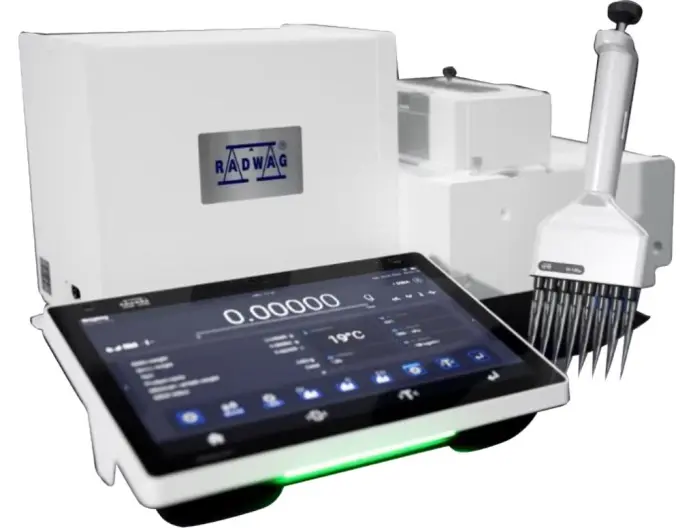
- Pipettes are precision instruments used in life sciences, chemistry, medical labs, etc., to dispense very small volumes of liquid. Calibration ensures that the volume delivered by the pipette corresponds accurately to the nominal volume (or is within accepted error tolerances). Errors in pipetting lead to systematic bias, affecting experiments’ reproducibility, accuracy of assays, drug formulations, etc.
- Multichannel pipettes are pipettes with multiple tips (e.g. 8-, 12-channel) that allow simultaneous dispensing, saving time especially in high-throughput settings (ELISA, PCR plates, 96- or 384-well plates, etc.). But multichannel pipettes complicate calibration, because each channel must be individually accurate (or within acceptable error), and there are more sources of error (channel variation, alignment, tip issues, evaporation, etc.).
- Automatic calibration devices reduce the manual labor, variation, and risk of human error. They automate steps like dispensing, weighing (gravimetric method), temperature/air monitoring, data collection. They increase repeatability, standard compliance (e.g. ISO 8655), and throughput.
- RADWAG is a well-known manufacturer of precision balances, pipette calibration devices, etc. They have a product line called AP-12.xY (e.g. AP-12.1.5Y, AP-12.5Y) for automatic multichannel pipette calibration. I’ll focus on those.
The RADWAG AP-Series: AP-12.1.5Y & AP-12.5Y
From the RADWAG site, here are the main models and their basic specs.
| Model | Maximum capacity | Readability / Resolution | Suitable Volume Range / Pipette Types | Key Advantages / Distinctions |
| AP-12.1.5Y | 18 g | 1 µg (i.e. 0.001 mg) +2+2 | Suitable for single- and multichannel micropipettes; nominal volumes from 0.5 µl (very small volumes) up to full channels of fixed/variable pipettes; up to 12 channels | High precision (especially at very low volumes), excellent for very small volume work; very fine repeatability and linearity; advanced stabilization / separation chamber to reduce disturbances. +2+2 |
| AP-12.5Y | 52 g | 0.01 mg (10 µg) resolution | Works for multichannel pipettes starting above ~10 µl volumes, can also do single-channel; up to 12 channels | Much higher capacity so can handle larger delivery volumes more comfortably; speed advantage; more robust for higher liquid volumes; faster cycle times. +2+2 |
Key Features & Innovations
These devices are packed with design and functional features that aim to satisfy both metrology/quality requirements and user-ergonomics. I’ll list them in categories.
a. Measurement Accuracy & Environmental Control
- Readability: Especially for AP-12.1.5Y, 1 µg step is extremely fine. This makes it suitable for small volumes where even tiny errors (evaporation, meniscus, pipette tip) are proportionally large. +2+2
- Separation chamber: For AP-12.1.5Y, the measurement path is isolated, to minimize effects of air currents or ambient disturbance. This helps ensure stable readings and repeatability.
- Ambient conditions monitoring: Sensors like THB S (for ambient air conditions) and THB W (for liquid temperature) are included to track temperature, humidity, liquid temperature. That is required by ISO 8655 standard for reliable gravimetric pipette calibration. +2+2
- Linearity, repeatability specs: For instance, AP-12.1.5Y: standard repeatability at 5% of Max is ~2.8 µg; for full Max ~3-4 µg depending on channel type.
b. Automation & Speed
- Automatic procedures: The device automates much of the pipette calibration workflow: dispensing, weighing, data collection, report generation. +2+2
- Multichannel checking in one cycle: For a 12-channel pipette, all channels can be checked in one run (rather than having to do them individually).
- Pumps to remove liquid: When calibrating, excess liquid must be removed; these devices offer pump(s) that can empty multiple vessels (4 vessels simultaneously) when dealing with multichannel pipettes. That speeds up cleaning / resetting between runs.
- Typical times: For example, with AP-12.5Y, calibrating a 12-channel pipette fully (variable volumes) takes under 60 minutes. For constant volume—under 20 minutes.
c. Usability & Data Handling
- User interface: Colour touchscreen (10″), multilingual menus, intuitive UX. +2+2
- Databases: The device includes an editable database of pipettes (so you can pre-enter pipette IDs, types, volumes etc.), and contains maximum permissible error values per ISO 8655. Also a report database for measurements and error values. User can choose report content and format.
- Data export / secure storage: Transfer of results to customer computer applications; internal procedure reporting.
- Alerts and ergonomic aids: Ambient light signaling when vessels are overfilled, etc. Vessel emptying design.
d. Compliance & Standards
- ISO 8655: These devices are designed so calibration conforms with ISO 8655, which is the standard governing piston pipettes (single-channel and multichannel) in terms of accuracy and precision. +2+2
- Mass standards calibration: The balance part has provision for replacing the weighing pan with one dedicated to checking/calibrating the balance itself, using mass standards. This helps ensure internal calibration of the measurement device.
Technical Specifications (More In Depth)
Here’s a more technical breakdown, largely from RADWAG datasheets. vetek.com+3+3+3
AP-12.1.5Y
- Max capacity: 18 g
- Readability (d): 1 µg
- Tare range: −18 g to 8 g (i.e. can subtract full load etc.)
- Repeatability:
5% Max ⇒ ~2.8 µg
At maximum load, for single-channel: ~3 µg; multichannel: ~4 µg - Linearity: ±0.01 mg
- Stabilization time: maximum 10 seconds to stable reading after loading etc.
- Maximum volume for weighing vessels: about 4.5 ml per vessel for AP-12.1.5Y, in multichannel context.
- Display & connectivity: 10" graphic colour touchscreen; ports: USB-A x2, USB-C, RS-232, HDMI, Ethernet, Wi-Fi, Hotspot.
- Physical size & weight: ~605×560×775 mm; net weight ~17 kg (gross ~23 kg)
AP-12.5Y
- Max capacity: 52 g
- Readability: 0.01 mg (10 µg)
- Repeatability: Standard repeatability 5% Max ~5 µg; at Max ~10 µg for multichannel etc.
- Linearity: ±0.03 mg
- Stabilization time: ~4 seconds
- Max volume of vessels: up to ~12 ml (vessel size) for this model.
- Other physical/connectivity similar (touchscreen, same interface types) but heavier (gross weight ~30 kg) due to higher capacity.
Applications & Use Cases
These devices have a broad set of possible users:
- Core research / academic labs where high throughput pipetting is routine (e.g. molecular biology, biotech, genomics labs using 96-well, 384-well plates). Ensures reproducibility.
- Clinical / diagnostic labs where pipetting error can translate to diagnostic error.
- Pharmaceuticals / GMP / QC labs where pipette calibration is regulated; good documentation, traceability, compliance are essential.
- Contract testing / calibration service providers who calibrate pipettes from external clients: speed, accuracy, report generation, and ability to handle many pipettes/channel-types is very useful.
- Manufacturing / LIMS-integrated Labs where data must be recorded, transferred, tracked (e.g. sample tracking, audit, etc.).
Advantages
Summarizing the benefits of using such automated multichannel pipette calibration devices (especially RADWAG’s AP-series):
- High accuracy and precision: Fine resolution, environmental monitoring, stable measurement path reduce measurement noise and error.
- Time savings: Automation and simultaneous channel testing dramatically reduce time versus manual gravimetric calibration. E.g., AP-12.5Y can do a 12-channel pipette in ~20 min constant volume, or <1 hour for variable volumes.
- Reduced human error: Consistency in procedure, less dependence on operator skill or fatigue.
- Better documentation & traceability: Editable pipette databases; internal reports; sensors for environment; compliance with ISO 8655.
- Ergonomics & usability: UI, alerts, automatic pan and pump features, vessel overfill alerts, etc., make operator tasks easier.
- Scalability: Up to 12 channels, multiple volume points.