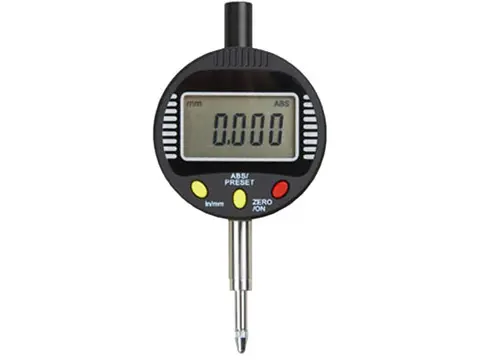
Digital indicators are electronic devices used to measure small linear distances with high accuracy. Unlike traditional dial indicators, digital indicators provide numerical readouts on an LCD or LED screen, making them easier to read and interpret. These devices are commonly used in manufacturing, engineering, automotive, and scientific research.
Characteristics of Digital Indicators
- High Accuracy and Precision: Digital indicators offer precise measurements down to micrometer levels.
- Digital Display: The LCD or LED screen eliminates parallax errors, ensuring readability.
- Data Storage and Transfer: Many digital indicators can store data and transfer it to computers or mobile devices for further analysis.
Applications of Digital Indicators
Manufacturing Industry
- Used for quality control and inspection of machined parts.
- Helps in alignment and calibration of industrial machinery.
Engineering and Research
- Essential in prototyping and product testing.
- Used for laboratory measurements in precision engineering.
Automotive Industry
- Helps in component testing such as brake pads and engine parts.
- Assists in engine performance measurement for tuning and diagnostics.
Medical and Healthcare Industry
- Used in medical device calibration for accurate diagnostics.
- Helps in laboratory research applications requiring precise measurements.
Construction and Structural Engineering
- Used in load testing and stress analysis.
- Helps in leveling and alignment in construction.
Aerospace Industry
- Critical in precision engineering in aircraft manufacturing.
- Used in maintenance and inspection of aircraft components.
Metalworking and Machining
- Ensures CNC machine alignment for precision cutting.
- Measures surface roughness for quality assessment.
Uses
Digital indicators are versatile devices used across various industries for precision measurement, monitoring, and control. Here are some key uses:
1. Manufacturing & Quality Control
- Measuring dimensions, thickness, and depth in machining processes
- Ensuring accuracy in precision engineering
- Detecting deviations and tolerances in production lines
2. Weighing & Measurement
- Used in digital weighing scales for industrial and laboratory applications
- Measuring force, torque, and pressure in testing equipment
- Displaying readings from load cells in force measurement systems
3. Industrial Automation
- Monitoring and controlling processes in CNC machines
- Used in robotics for precise movement and positioning
- Integrated into assembly lines to ensure uniformity
4. Laboratory & Scientific Research
- Measuring small displacements in research experiments
- Used in spectrophotometers and analytical balances for precision readings
- Assisting in data logging for scientific instruments
5. Aerospace & Automotive Industry
- Inspecting components in aircraft and vehicle manufacturing
- Monitoring engine and structural components
- Ensuring compliance with safety standards
6. Medical Equipment
- Used in digital pressure monitors and medical weighing scales
- Integrated into diagnostic devices for accurate readings
- Assisting in prosthetic development and rehabilitation technologies
7. Construction & Civil Engineering
- Measuring deflection, settlement, and alignment in structures
- Monitoring stress and strain in materials
- Ensuring precision in land surveying equipment
8. Food & Pharmaceutical Industry
- Ensuring accuracy in ingredient measurements for production
- Used in testing equipment for quality assurance
- Monitoring environmental conditions like humidity and temperature