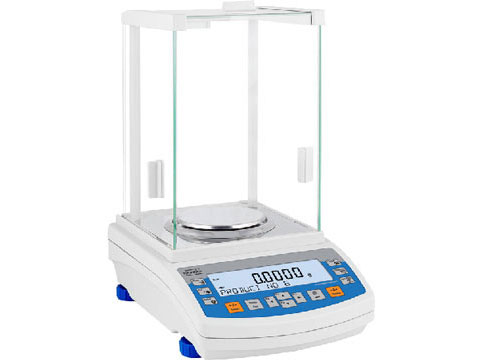
Analytical balances are a cornerstone of precision measurement in laboratories. Below, we address some of the most common technical questions related to these instruments, providing insights to help you understand their operation and usage.
What is an analytical balance, and how does it differ from a standard balance?
A: An analytical balance is a highly precise weighing instrument designed to measure small masses with a high degree of accuracy, typically up to 0.0001 grams (0.1 mg). The key differences between analytical and standard balances are:
- Precision: Analytical balances are far more sensitive and can measure minute quantities with exceptional accuracy.
- Draft Shields: They are equipped with draft shields to minimize the effect of air currents.
- Applications: Analytical balances are used for scientific experiments, pharmaceutical formulations, and chemical analysis, whereas standard balances are often used for less precise measurements.
What is the role of calibration in analytical balances?
A: Calibration ensures the accuracy and reliability of analytical balances. It adjusts the instrument to eliminate errors caused by factors like:
- Environmental changes (temperature, humidity).
- Wear and tear over time.
There are two types of calibration:
- Internal Calibration: The balance automatically adjusts using an internal weight at regular intervals or environmental triggers.
- External Calibration: Performed manually using certified calibration weights.
Regular calibration is essential for maintaining measurement accuracy.
Why is the environmental setup important for using an analytical balance?
A: Analytical balances are sensitive to environmental factors, and an improper setup can result in inaccurate readings. Consider the following:
- Vibration: Place the balance on a stable, vibration-free surface.
- Temperature Stability: Avoid direct sunlight and rapid temperature fluctuations.
- Air Currents: Use the draft shield and keep the balance away from windows, fans, or air conditioners.
- Humidity Control: High humidity can affect precision, so maintaining moderate levels is crucial.
What is the significance of readability in an analytical balance?
A: Readability refers to the smallest difference in mass that the balance can detect and display. For example:
- A balance with a readability of 0.0001 g (0.1 mg) can detect mass changes as small as 0.1 mg. High readability is essential for applications requiring precise formulations, such as in pharmaceuticals or chemical research.
What are some common errors when using an analytical balance, and how can they be avoided?
A: Common errors include:
- Improper Taring: Always zero the balance with the container before weighing the sample.
- Overloading: Never exceed the maximum capacity of the balance.
- Not Accounting for Static Electricity: Use anti-static devices if working with materials prone to static buildup.
- Inconsistent Handling: Always use clean and dry containers and avoid touching them with bare hands to prevent contamination.
How does temperature affect analytical balances?
A: Temperature changes can cause:
- Thermal Drift: Expansion or contraction of materials, leading to inaccurate readings.
- Sample Behavior: Volatile samples may evaporate, altering their mass.
To minimize these effects, allow the balance to acclimatize to room temperature and ensure that samples are stable at the working temperature.
What are key maintenance practices for an analytical balance?
A: To ensure longevity and accuracy:
- Regular Cleaning: Use a soft brush or lint-free cloth to clean the pan and draft shield.
- Periodic Calibration: Perform internal or external calibration as per the manufacturer’s recommendations.
- Avoid Overloading: Respect the balance’s weight capacity to prevent damage to the load cell.
- Professional Servicing: Schedule routine maintenance with certified technicians to check for wear and tear.
Can analytical balances measure liquids directly?
A: Analytical balances can measure liquids indirectly by:
- Using a clean, tared container to hold the liquid.
- Calculating the mass of the liquid by subtracting the container’s weight.
Direct measurement is discouraged because liquids can spill and damage the balance or lead to contamination.
What certifications and standards should analytical balances comply with?
A: Analytical balances should adhere to standards like:
- ISO/IEC 17025: For calibration and testing.
- GLP (Good Laboratory Practice): Ensures traceability and reliability.
- NIST (National Institute of Standards and Technology): For traceable calibration weights.
Compliance ensures the balance meets industry regulations and delivers accurate results.
What features should I look for when purchasing an analytical balance?
A: Key features to consider include:
- Readability and Capacity: Match the balance to your application needs.
- Internal Calibration: For automatic adjustments.
- Connectivity: USB or Ethernet for data transfer.
- User Interface: Intuitive controls for ease of use.
- Brand and Warranty: Opt for trusted brands with good customer support and warranties.
How does the sensitivity of an analytical balance impact its performance?
A: Sensitivity refers to the ability of an analytical balance to detect minute changes in weight. A high-sensitivity balance (e.g., 0.0001 g readability) ensures:
- Accurate detection of small samples.
- Reliable results for experiments requiring precision, such as micro-dosing in pharmaceutical research.
However, high sensitivity also means the balance is more susceptible to external disturbances like vibrations and air currents, making proper setup essential.
What is linearity in analytical balances, and why is it important?
A: Linearity is the balance’s ability to provide consistent weight readings across its entire measurement range. For example:
- A perfectly linear balance will give equally accurate readings whether measuring 1 g or 100 g.
- If linearity is off, the balance might show slight errors at higher or lower weights.
Linearity is corrected during calibration, often verified with certified calibration weights.
What is repeatability, and how can it be tested in an analytical balance?
A: Repeatability refers to the balance's ability to provide the same measurement for the same sample under identical conditions. To test:
- Weigh a standard weight multiple times.
- Calculate the standard deviation of the readings.
- A low standard deviation indicates good repeatability.
Repeatability is critical for ensuring consistent results in quality control processes.
Why is warm-up time necessary for analytical balances?
A: Warm-up time allows internal components, such as the load cell and electronic circuits, to stabilize for accurate measurements. Without proper warm-up:
- Initial readings may drift or fluctuate.
- Calibration may not be reliable.
Manufacturers often recommend a warm-up period of 30 minutes to 1 hour, especially after moving the balance or powering it off.
How do you choose the right weighing pan for an analytical balance?
A: The weighing pan plays a crucial role in accurate measurements. Consider:
- Size: Choose a pan that fits your samples without overhanging, which could cause airflow disturbances.
- Material: Use stainless steel pans for durability and resistance to corrosion; anti-static pans for samples prone to static buildup.
- Shape: Flat pans are ideal for solid objects, while concave pans help contain powders or liquids.
What are draft shields, and how do they improve balance performance?
A: Draft shields are transparent enclosures around the weighing pan that protect the balance from air currents, vibrations, and temperature fluctuations. They:
- Minimize external influences, ensuring stable readings.
- Are especially important for balances with high readability (e.g., 0.0001 g or finer).
- Should be closed properly before weighing to avoid airflow disturbances.
How does the tare function improve weighing efficiency?
A: The tare function allows users to reset the display to zero after placing a container or other support on the weighing pan. Benefits include:
- Simplifying measurements of net weight.
- Avoiding manual calculations.
- Reducing human errors during multi-step processes like formulation or mixing.
What are the common sources of static electricity in analytical balances, and how can they be mitigated?
A: Static electricity can cause fluctuations in weight readings. Sources include:
- Dry environments.
- Synthetic materials near the balance.
- Handling samples with gloves that generate static.
To mitigate static:
- Use anti-static devices like ionizers or grounding mats.
- Increase room humidity to 45–60%.
- Avoid using plastic containers when possible.

What is eccentric loading error, and how can it be avoided?
A: Eccentric loading error occurs when a sample is not placed at the center of the weighing pan, leading to inaccurate readings. To avoid:
- Always place the sample in the pan’s center.
- Use the correct pan size for the sample.
- Check for mechanical issues like misalignment of the weighing mechanism.
What is the role of a load cell in an analytical balance?
A: The load cell is the core component responsible for converting the mass of a sample into an electrical signal. It works by:
- Detecting deformation in a strain gauge or electromagnetic force compensation mechanism.
- Translating the deformation into a digital reading.
High-quality load cells ensure better accuracy, durability, and resistance to external influences.
How does vibration isolation improve the accuracy of analytical balances?
A: Vibrations from equipment, foot traffic, or building infrastructure can cause unstable readings. To isolate vibrations:
- Use vibration-dampening pads or tables.
- Place the balance on a heavy, stable surface.
- Position the balance away from machinery or high-traffic areas.
What is the significance of minimum weight in an analytical balance?
A: Minimum weight is the smallest mass that can be accurately measured while maintaining a specified level of uncertainty. Factors influencing minimum weight include:
- Balance readability.
- Environmental conditions (vibrations, air currents).
- Regulatory requirements (e.g., USP <41> guidelines).
Always verify the minimum weight before using the balance for critical measurements.
How do you account for buoyancy effects in analytical balances?
A: Buoyancy effects occur due to the displacement of air when weighing, especially in high-precision applications. To account for this:
- Use correction formulas for air density if extreme accuracy is needed.
- Weigh samples in controlled environments with stable air pressure and humidity.
How often should analytical balances be serviced and recalibrated?
A: The servicing and calibration frequency depends on:
- Frequency of use.
- Environmental conditions.
- Regulatory requirements.
General guidelines include:
- Daily or weekly user calibration checks using test weights.
- Professional calibration at least once a year, or more frequently for critical applications.
Can analytical balances be integrated with software systems?
A: Yes, modern analytical balances often include connectivity features like:
- USB, RS-232, or Ethernet ports for data transfer.
- Software integration with LIMS (Laboratory Information Management Systems) for data logging and analysis.
- Bluetooth or Wi-Fi for wireless operations.
These integrations improve workflow efficiency and ensure traceability in compliance with regulatory standards.