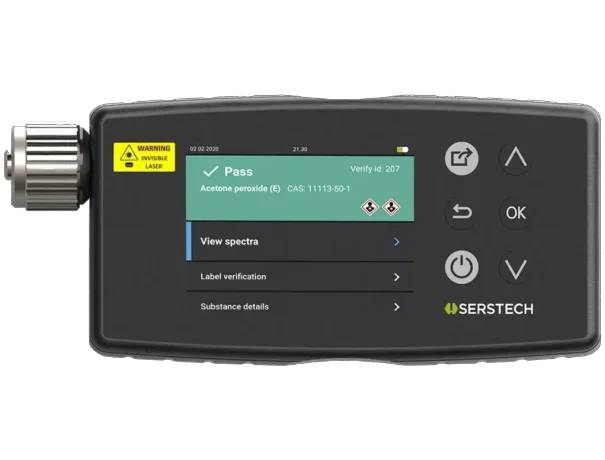
Raman spectroscopy is an advanced, highly precise, and non-destructive analytical technique used to identify materials, investigate molecular structures, and analyze chemical compositions. By providing a unique molecular "fingerprint" for the analyzed substance, this method allows for the clear differentiation of materials with very similar compositions, including isomers and polymorphs.
How Does a Raman Spectrometer Work?
The operating principle of the instrument is based on a physical phenomenon known as Raman Scattering, discovered by the Indian physicist Sir C.V. Raman in 1928.
Laser Irradiation: The spectrometer directs a concentrated monochromatic light beam (typically a laser source at wavelengths such as 532nm, 785nm, or 1064nm) at the sample.
Molecular Interaction: When photons from the laser strike the molecules of the substance, the vast majority scatter back at the exact same wavelength and energy. This is known as Rayleigh scattering (elastic scattering).
Raman Scattering (Inelastic Scattering): A very small fraction of the photons (about 1 in a million) exchange energy with the molecules due to the vibrations of the chemical bonds. These photons scatter back at a different wavelength (either higher or lower) than the original light.
Signal Processing: The instrument collects the scattered light, filters out the dominant Rayleigh scattering, and analyzes the energy differences (known as the Raman Shift). The resulting data is translated into a spectrum—a graph displaying a sequence of peaks, where each peak represents the vibration of a specific chemical bond within the molecule.
Primary Applications and Uses
Due to its versatility and high precision, Raman spectroscopy has become an essential tool across a wide range of scientific and industrial disciplines:
1. Pharmaceutical Industry
Quality Control (QC): Rapid verification of incoming raw materials directly through transparent packaging, such as plastic bags or glass bottles.
Polymorphism Identification: Distinguishing between different crystalline structures of the same active pharmaceutical ingredient (API), which critically affects dissolution rates in the body.
Counterfeit Detection: Quick screening of finished products in the market to verify the authenticity and presence of the active ingredients.
2. Forensics and Security
Narcotics and Explosives Detection: Handheld Raman devices allow law enforcement and bomb squads to identify suspicious powders, liquids, and chemicals in the field instantly, without direct physical contact with the hazardous material.
Crime Scene Analysis: Identifying trace evidence like paint, ink, fibers, and toxins without destroying or compromising the physical evidence.
3. Materials Science and Nanotechnology
Carbon and Graphene Analysis: Characterization of carbon nanotubes (CNTs), graphene, and diamonds, including determining the number of layers, crystal lattice defects, and mechanical stress.
Semiconductors: Analyzing internal stress and strain in silicon wafers and microelectronic chips.
4. Geology, Mineralogy, and Art
Gemology: Differentiating between natural, synthetic, or counterfeit gemstones without causing any scratches or structural damage.
Art Conservation and Archaeology: Analyzing pigments in ancient paintings, manuscripts, and sculptures for historical dating and authentication.
Key Technological Advantages
Non-Destructive Testing (NDT): The sample remains completely intact and unaltered, allowing it to be used for further testing.
No Sample Preparation Required: Unlike many other chemical analysis methods, there is no need to dissolve, grind, or mix the material with reagents.
Water Insensitivity: Water is a very weak Raman scatterer, making this technique ideal for analyzing aqueous solutions, suspensions, and wet biological samples (unlike FTIR technology, where water creates significant signal interference).
Rapid Results: Delivers highly accurate data and material identification within a matter of seconds.