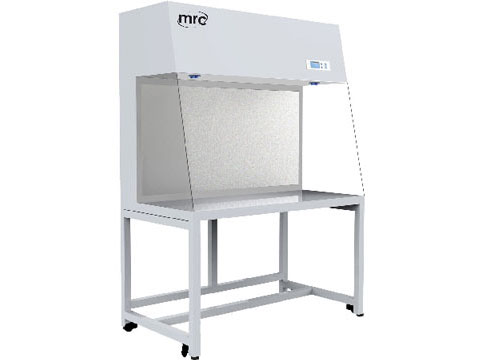
Questions and answers laminar flow cabinet
Q: What are the standard airflow velocity requirements for a laminar flow cabinet?
A: The standard airflow velocity for a laminar flow cabinet typically ranges between 0.3 to 0.5 meters per second (60 to 100 feet per minute). This ensures a uniform, unidirectional airflow that minimizes contamination.
Q: What is the difference between vertical and horizontal laminar flow cabinets in terms of contamination control?
A: In a vertical laminar flow cabinet, the air moves downward from the top of the cabinet, which reduces the risk of contamination from particles generated by the operator's hands. It also provides better clearance for larger equipment. In a horizontal laminar flow cabinet, air flows from the back of the cabinet toward the user, offering better protection for samples but a higher risk of contamination from operator movement.
Q: What type of HEPA/ULPA filters are used in laminar flow cabinets, and what is their efficiency?
A: Laminar flow cabinets use HEPA (High-Efficiency Particulate Air) filters or ULPA (Ultra-Low Penetration Air) filters.
- HEPA filters have an efficiency of 99.99% at 0.3 microns.
- ULPA filters provide even higher efficiency, removing 99.999% of particles down to 0.12 microns.
Q: How is air recirculated and filtered in a laminar flow cabinet?
A: The cabinet pulls in ambient air through a pre-filter, then directs it through a HEPA/ULPA filter to remove contaminants. In vertical flow cabinets, the clean air moves downward and exits through the front opening. In horizontal flow cabinets, it flows toward the user. Air is not recirculated inside the cabinet but rather expelled, ensuring a continuous supply of clean air.
Q: What are the ISO classifications applicable to laminar flow cabinets?
A: Laminar flow cabinets typically comply with ISO 14644-1 cleanroom standards:
- ISO Class 5: Common for pharmaceutical and medical applications (≤3,520 particles of ≥0.5µm per cubic meter).
- ISO Class 4 or better: Used in more stringent environments requiring ultra-clean air.
Q: What is the typical noise level (dB) of a laminar flow cabinet during operation?
A: The noise level of a laminar flow cabinet usually ranges between 50 to 65 dB. This is comparable to a quiet office environment or normal conversation.
Q: What are the minimum and maximum working temperatures for a laminar flow cabinet?
A: Laminar flow cabinets typically operate within a temperature range of 15°C to 40°C (59°F to 104°F). However, extreme temperatures can affect the efficiency of filters and airflow.
Q: What are the standard airflow velocity requirements for a laminar flow cabinet?
A: The standard airflow velocity for a laminar flow cabinet typically ranges between 0.3 to 0.5 meters per second (60 to 100 feet per minute). This ensures a uniform, unidirectional airflow that minimizes contamination.
Q: What is the difference between vertical and horizontal laminar flow cabinets in terms of contamination control?
A: In a vertical laminar flow cabinet, air moves downward from the top of the cabinet, reducing contamination risks from particles generated by the operator's hands. It also provides better clearance for larger equipment. In a horizontal laminar flow cabinet, air flows from the back of the cabinet toward the user, offering better sample protection but a higher risk of contamination from operator movement.
Q: What type of HEPA/ULPA filters are used in laminar flow cabinets, and what is their efficiency?
A: Laminar flow cabinets use HEPA (High-Efficiency Particulate Air) filters or ULPA (Ultra-Low Penetration Air) filters:
- HEPA filters remove 99.99% of particles at 0.3 microns.
- ULPA filters remove 99.999% of particles down to 0.12 microns, offering higher efficiency.
Q: How is air recirculated and filtered in a laminar flow cabinet?
A: The cabinet pulls in ambient air through a pre-filter, then directs it through a HEPA/ULPA filter to remove contaminants. In vertical flow cabinets, the clean air moves downward and exits through the front opening. In horizontal flow cabinets, it flows toward the user. Air is not recirculated inside the cabinet but rather expelled, ensuring a continuous supply of clean air.
Q: What are the ISO classifications applicable to laminar flow cabinets?
A: Laminar flow cabinets typically comply with ISO 14644-1 cleanroom standards:
- ISO Class 5: Common for pharmaceutical and medical applications (≤3,520 particles of ≥0.5µm per cubic meter).
- ISO Class 4 or better: Used in more stringent environments requiring ultra-clean air.
Q: What is the typical noise level (dB) of a laminar flow cabinet during operation?
A: The noise level of a laminar flow cabinet usually ranges between 50 to 65 dB, comparable to a quiet office environment or normal conversation.
Q: What are the minimum and maximum working temperatures for a laminar flow cabinet?
A: Laminar flow cabinets typically operate within a temperature range of 15°C to 40°C (59°F to 104°F). Extreme temperatures can affect the efficiency of filters and airflow.
Q: What materials are commonly used for the work surface and body of a laminar flow cabinet?
A: The work surface is typically made of stainless steel (SS 304 or SS 316) for durability and chemical resistance. The body is often constructed from powder-coated steel, stainless steel, or aluminum for strength and corrosion resistance. Some cabinets also feature polypropylene or glass panels for visibility and easy cleaning.
Q: What are the standard dimensions available for laminar flow cabinets?
A: Standard laminar flow cabinets come in various sizes, with widths typically ranging from 2 feet (600 mm) to 6 feet (1800 mm). Common dimensions include:
- 2 feet (600 mm) width × 2 feet (600 mm) depth × 2.5 feet (750 mm) height
- 3 feet (900 mm) width × 2 feet (600 mm) depth × 2.5 feet (750 mm) height
- 4 feet (1200 mm) width × 2 feet (600 mm) depth × 2.5 feet (750 mm) height
- 6 feet (1800 mm) width × 2 feet (600 mm) depth × 2.5 feet (750 mm) height
Q: How does the UV light function in a laminar flow cabinet for sterilization?
A: The UV light in a laminar flow cabinet helps sterilize the work area by inactivating microorganisms such as bacteria, viruses, and fungi. It is used before and after operations, not during, as UV exposure can be harmful to users. For effective sterilization, UV light should be operated for 15 to 30 minutes before use.
Q: How does an anti-vibration system improve the performance of laminar flow cabinets?
A: An anti-vibration system minimizes disturbances to sensitive work, such as microbiological experiments, electronics assembly, and precision weighing. It reduces air turbulence and movement, ensuring a stable working environment for delicate operations.
Q: What are the recommended ergonomic features for an efficient laminar flow cabinet design?
A: Ergonomic features improve user comfort and efficiency. Recommended features include:
- Adjustable work height to reduce strain on the user’s arms and back.
- Sloped front panel for a comfortable working posture.
- Soft-touch controls for ease of operation.
- LED lighting to provide clear visibility without glare.
- Low-noise fans to minimize distractions.
- Armrest supports to prevent fatigue during extended use