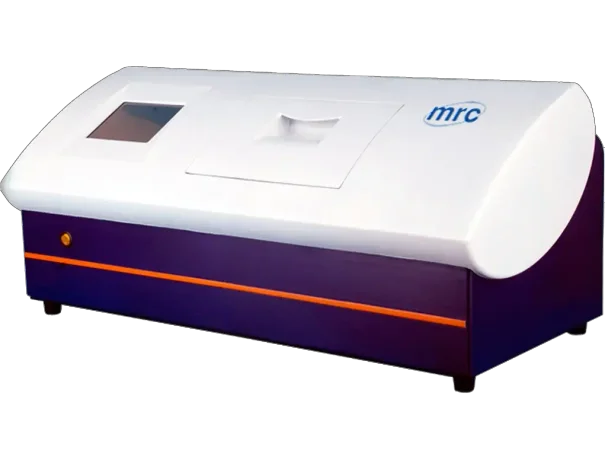
Polarimeter–Frequently Asked Questions
1. How does a polarimeter distinguish between dextrorotatory and levorotatory compounds?
A polarimeter measures the direction in which polarized light is rotated when it passes through an optically active compound.
-
Dextrorotatory (d-, +): The plane of polarized light is rotated to the right (clockwise). The polarimeter records a positive value for the angle of rotation.
-
Levorotatory (l-, –): The plane of polarized light is rotated to the left (counterclockwise). The polarimeter records a negative value for the angle of rotation.
By comparing the observed rotation to the zero reference (no sample or an achiral solvent), the instrument identifies whether the compound is dextrorotatory or levorotatory.
2. Explain the function of the polarizer and analyzer in a polarimeter's optical path.
-
Polarizer: The polarizer converts ordinary light into plane-polarized light, restricting vibrations to a single direction. This ensures that any rotation detected is due solely to the optically active substance.
-
Analyzer: Positioned after the sample, the analyzer is a second polarizing element. It detects the angle by which the plane of polarized light has been rotated. The analyzer’s movement (manual or automatic, depending on instrument type) quantifies the degree of optical rotation.
Together, these components enable precise measurement of how much and in which direction the sample rotates polarized light.
3. What is the difference between "observed rotation" and "specific rotation," and what factors influence each?
-
Observed rotation ([α]obs): The raw angular displacement (in degrees) measured by the polarimeter. It depends directly on sample concentration, path length, temperature, and wavelength.
-
Specific rotation ([α]): A normalized value that allows comparison across experiments and laboratories. It is calculated using the formula:
[α]=l⋅cαobs where:
Factors influencing observed rotation: concentration, path length, wavelength, temperature.
Factors influencing specific rotation: intrinsic molecular structure, solvent, wavelength, and temperature.
4. Why is it important for the light source in a polarimeter to be monochromatic?
Monochromatic light ensures that only one wavelength passes through the sample. This is critical because optical rotation is wavelength-dependent (known as optical rotatory dispersion).
-
If multiple wavelengths were used, rotations would differ for each, producing mixed or inaccurate results.
-
Sodium D-line (589 nm) has historically been the standard, but modern polarimeters often use high-intensity LEDs with narrow interference filters for precise wavelength control.
Monochromatic light guarantees reliable, reproducible, and comparable measurements.
5. Describe the purpose of a Peltier temperature control system in a modern polarimeter. Why is temperature control critical for accurate measurements?
Without temperature stabilization, two identical solutions measured at different temperatures could yield different values.
6. What is the standard path length for a polarimeter sample tube, and how does varying this length affect the measurement?
-
Standard path length: 100 mm (10 cm, or 1 dm).
-
Effect of varying length: Optical rotation is directly proportional to path length.
For example:
This proportionality is why specific rotation is used—it removes the influence of path length and concentration.
7. What does the term "accuracy" refer to in a polarimeter's specifications (e.g., ±0.01°), and why is this a key consideration for pharmaceutical applications?
-
Accuracy specifies how close the measured optical rotation is to the true or standard reference value. A spec of ±0.01° means the instrument’s reading deviates at most by 0.01 degrees.
-
Importance in pharmaceuticals:
-
Many active pharmaceutical ingredients (APIs) are chiral, and enantiomeric purity determines drug safety and efficacy.
-
Regulatory agencies (e.g., FDA, EMA) require precise measurements to confirm identity, concentration, and purity.
-
Even small deviations can cause batch rejection or regulatory non-compliance.
Therefore, accuracy is a critical specification for polarimeters used in pharmaceutical quality control.
8. How do modern polarimeters, such as those that use high-intensity LEDs, differ from older models that relied on sodium lamps?
These improvements make modern polarimeters more efficient, accurate, and user-friendly.