pendulum tester is a precision instrument used to measure the hardness or impact resistance of materials. It operates on the principle of a swinging pendulum, which exerts a known force on the test material, allowing for the determination of its mechanical properties.
Measuring hardness or impact resistance is critical in various industries, including automotive, construction, and manufacturing. These properties determine how a material will perform under stress, ensuring safety, durability, and reliability in its applications.
What is a Pendulum Tester?
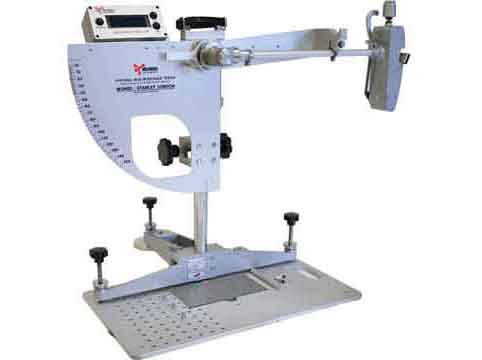
A pendulum tester is designed to assess a material's ability to withstand force by recording the energy absorbed during a pendulum’s swing. This energy loss is directly related to the material's hardness or impact resistance.
The Science Behind Pendulum Testers
Basic Physics of Pendulums
A pendulum consists of a weight suspended from a fixed point, allowing it to swing freely under the influence of gravity. The energy of the pendulum is highest at the lowest point of its swing, where it strikes the material being tested.
How a Pendulum Tester Measures Force
When a pendulum strikes a material, it transfers kinetic energy to the material. The energy absorbed by the material reduces the pendulum's swing, and this reduction is measured to determine the material's hardness or impact resistance.
Factors Affecting Accuracy
Several factors can influence the accuracy of a pendulum test, including the calibration of the device, the angle of swing, and the environmental conditions during testing. Ensuring consistent and controlled testing environments is essential for reliable results.
Introduction to Hardness Testing
Hardness is a material's resistance to deformation, typically measured by the depth or size of an indentation made by a specific force. Pendulum testers provide a dynamic method of assessing hardness by measuring energy absorption.
Procedure for Using a Pendulum Tester to Measure Hardness
To measure hardness with a Skid Resistance Tester(pendulum tester), the material is positioned at the pendulum's impact point. The pendulum is then released, and the energy absorbed during the impact is recorded. This energy is converted into a hardness value using a specific formula.
. Interpreting Results
The results from a pendulum hardness test are usually presented as a numerical value, which can be compared against industry standards to determine if the material meets the required hardness levels.
Introduction to Impact Resistance Testing
Impact resistance measures a material's ability to absorb energy and withstand shock or impact without fracturing. This property is crucial for materials used in high-stress environments.
Procedure for Using a Pendulum Tester to Measure Impact Resistance
The process for measuring impact resistance is similar to hardness testing. The pendulum tester is calibrated for impact testing, and the material is struck with a controlled force. The energy absorbed by the material, reflected in the pendulum's reduced swing, is used to calculate impact resistance.
Interpreting Results
Impact resistance results are essential for assessing a material's durability. These values help engineers and designers choose appropriate materials for applications where impact loads are a concern.
Applications of Pendulum Testers
Industrial Applications
Pendulum testers are widely used in industries such as automotive and aerospace to ensure materials meet safety and performance standards. The ability to measure hardness and impact resistance is critical in these fields.
Research and Development
In R&D, pendulum testers are used to explore new materials and composites, providing valuable data on their mechanical properties. This data is essential for developing innovative materials with enhanced performance characteristics.
Quality Control
Quality control processes often incorporate pendulum testing to verify that materials conform to specified standards before they are used in production. This step helps prevent failures in the final product.