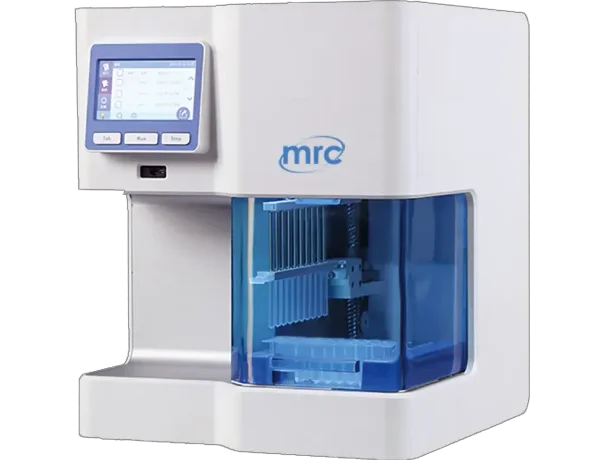
Nucleic Acid Purification System – Frequently Asked Questions (FAQ)
Q1. What are the main types of nucleic acid purification systems, and how do their underlying principles differ?
- Silica column-based systems: Rely on nucleic acids binding to silica membranes in the presence of chaotropic salts, followed by washing and elution.
- Magnetic bead-based systems: Use coated magnetic particles that selectively bind DNA or RNA, allowing automation and high-throughput workflows.
- Precipitation-based methods: Involve alcohol (ethanol/isopropanol) precipitation for concentrating nucleic acids.
- Enzymatic cleanup kits: Use DNases, RNases, or proteases to remove contaminants.
Each differs in scalability, purity level, and ease of automation.
Q2. What factors should I consider when choosing a system for my lab, such as throughput, sample type, and required purity?
Sample type (blood, plant tissue, bacterial culture, viral RNA).
- Throughput needs (single prep vs. 96/384-well plates).
- Purity requirements (clinical-grade, sequencing-ready, or general research).
- Automation compatibility (manual kits vs. robotic systems).
- Budget and operating costs (reagents, consumables, maintenance).
Q3. How do automated systems compare to manual methods in terms of time, cost, and reproducibility?
- Automated systems save time, reduce human error, and improve reproducibility, especially in high-throughput labs.
- Manual methods are cheaper initially but require more labor and are prone to variability.
- Over the long term, automation often lowers per-sample costs when processing large volumes.
Q4. What are some common issues encountered during nucleic acid purification, such as low yield or poor purity, and how can they be resolved?
- Low yield: Often caused by insufficient lysis or degraded samples. Solution: optimize lysis buffers and ensure proper storage.
- Poor purity (low A260/A280): Indicates protein contamination. Solution: adjust wash steps or repeat purification.
- Low A260/A230 ratio: Suggests salt or phenol contamination. Solution: add extra ethanol wash.
- Fragmentation: Caused by harsh lysis or freeze-thaw cycles. Solution: gentle handling and nuclease inhibitors.
Q5. Can a single system be used to purify both DNA and RNA, or are specialized systems required for each?
- DNA-specific kits (genomic DNA, plasmids).
- RNA-specific kits (mRNA, total RNA, viral RNA).
Hybrid kits exist, but for high-sensitivity applications like RT-qPCR or NGS, dedicated systems are recommended.
Q6. What are the typical operating costs, including reagents and consumables, for a nucleic acid purification system?
- Manual silica kits: $1–3 per sample.
- Magnetic bead kits (manual/automated): $2–6 per sample.
- High-throughput automated cartridges: $3–10 per sample.
Costs depend on sample volume, purity grade, and supplier agreements.
Technical Queries
Q7. How does the magnetic bead method of purification specifically work, and what are the key chemical interactions involved in the binding and elution steps?
- Binding: Magnetic beads are coated with silica or functional groups. In the presence of chaotropic salts, nucleic acids bind to the beads via hydrogen bonding and electrostatic interactions.
- Washing: Contaminants are removed with ethanol-based buffers.
- Elution: Nucleic acids are released in low-salt or water-based buffers.
Q8. What is the significance of the A260/A280 ratio and the A260/A230 ratio in assessing the purity of a nucleic acid sample, and what do different values indicate?
- A260/A280 ratio: Ideal ~1.8 for DNA, ~2.0 for RNA. Lower values (<1.7) suggest protein contamination.
- A260/A230 ratio: Ideal 2.0–2.2. Lower values (<1.5) indicate contamination by salts, phenol, or carbohydrates.
Q9. What are the optimal lysis conditions (e.g., buffer composition, temperature, and incubation time) for different sample types, such as plant tissue versus whole blood?
- Whole blood: Detergent-based lysis with proteinase K, ~56 °C incubation.
- Plant tissue: Strong denaturing buffers (guanidinium salts), mechanical disruption (bead beating).
- Bacteria: Enzymatic digestion (lysozyme) + detergents.
- Conditions must balance cell disruption with preservation of nucleic acid integrity.
Q10. How do systems prevent cross-contamination between samples, especially in high-throughput models?
- Sealed cartridges or consumables.
- Disposable filter tips with liquid-level detection.
- UV decontamination within automated instruments.
- Optimized workflows with minimal sample handling.
Q11. What are the key technical specifications to look for in a system, such as sample throughput, processing volume, and temperature control ranges?
- Throughput: Single sample → 96/384-well capacity.
- Processing volume: From microliters (qPCR prep) to milliliters (large-volume blood).
- Temperature control: Range typically from 4 °C (RNA stabilization) to 95 °C (denaturation).
- Integration: Compatibility with downstream applications (PCR, sequencing).
Q12. What is the average magnetic bead recovery efficiency for a typical automated system?
Most modern systems achieve >90–95% bead recovery efficiency, ensuring minimal loss of nucleic acids during purification. Optimized elution conditions can push recovery closer to 98%.