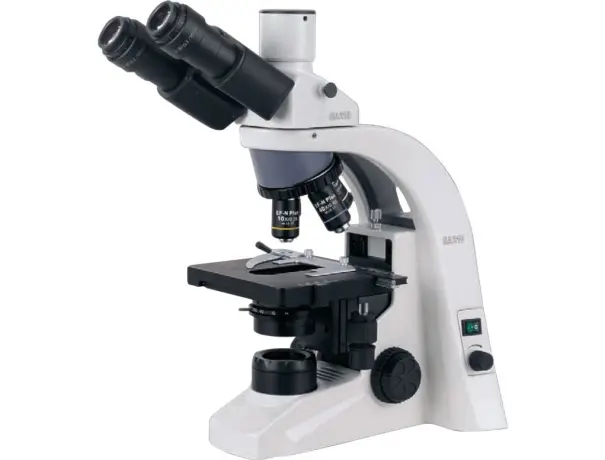
Live-cell imaging is a powerful technique used in biological research to observe cellular processes in real-time. It allows scientists to study cell behavior, dynamics, and interactions under physiological conditions. Unlike fixed-cell imaging, live-cell imaging captures the dynamics of living cells over extended periods without causing significant damage. This article explores how live-cell imaging works with biological microscopes, the key components involved, and the applications of this technology.
Principles of Live-Cell Imaging
Live-cell imaging involves monitoring live specimens using optical microscopy techniques. The process requires specialized equipment to maintain cell viability while capturing high-resolution images. The main principles of live-cell imaging include:
- Non-Invasive Imaging: Cells must be observed without disturbing their normal functions.
- Environmental Control: Temperature, humidity, and gas concentrations (CO2 and O2) must be regulated to mimic physiological conditions.
- Contrast Enhancement: Techniques like fluorescence and phase contrast microscopy improve visibility of cellular structures.
- Time-Lapse Imaging: Continuous or periodic image acquisition enables the study of dynamic processes.
Key Components of Live-Cell Imaging Systems
1. Biological Microscopes
Biological microscopes used for live-cell imaging are typically inverted microscopes. These allow for easy access to cell culture dishes and facilitate imaging from below.
- Brightfield Microscopes: Provide simple contrast but lack specificity.
- Phase Contrast Microscopes: Enhance contrast in transparent cells without staining.
- Fluorescence Microscopes: Use fluorophores to highlight specific cellular structures.
- Confocal Microscopes: Improve optical sectioning by eliminating out-of-focus light.
- Super-Resolution Microscopes: Provide nanometer-scale resolution for detailed imaging.
2. Live-Cell Chambers
Live-cell imaging requires a specialized chamber that maintains optimal environmental conditions. These chambers include:
- Temperature control systems (e.g., heated stages or incubators)
- CO2 and O2 regulation to maintain pH balance
- Humidity control to prevent evaporation of media
3. Fluorescent Dyes and Reporters
Fluorescence microscopy is widely used in live-cell imaging due to its ability to label specific molecules. Common fluorescent markers include:
- GFP (Green Fluorescent Protein): Genetically encoded marker for tracking proteins.
- DAPI: Stains DNA to visualize nuclei.
- Calcium Indicators: Monitor cellular signaling pathways.
- Membrane Dyes: Highlight cell boundaries and morphology.
4. High-Speed Cameras
Modern live-cell imaging relies on high-speed, sensitive cameras, such as:
- CMOS (Complementary Metal-Oxide-Semiconductor) Cameras: Fast imaging with low noise.
- EMCCD (Electron-Multiplying Charge-Coupled Device) Cameras: High sensitivity for low-light conditions.
5. Automated Image Acquisition Software
Software solutions enable automated time-lapse imaging, data analysis, and image processing. These programs provide:
- Autofocus mechanisms
- Image stitching for large field-of-view analysis
- Quantification tools for cellular tracking and morphology analysis
Techniques Used in Live-Cell Imaging
1. Fluorescence Microscopy
Fluorescence microscopy uses fluorophores to visualize specific cellular components. Excitation light stimulates the fluorophores, causing them to emit light at a different wavelength, which is then captured by the microscope.
2. Phase Contrast Microscopy
This technique enhances contrast in unstained, transparent samples by exploiting differences in refractive index, making internal structures more visible.
3. Differential Interference Contrast (DIC) Microscopy
DIC uses polarized light to create high-contrast, pseudo-3D images of cells, improving visualization of structures like organelles and cytoskeletal elements.
4. Spinning Disk Confocal Microscopy
Unlike traditional confocal microscopy, spinning disk confocal microscopy allows for fast imaging with reduced phototoxicity, making it ideal for long-term live-cell imaging.
5. Total Internal Reflection Fluorescence (TIRF) Microscopy
TIRF selectively illuminates molecules near the cell membrane, reducing background fluorescence and improving signal-to-noise ratio for surface-related studies.
6. Super-Resolution Microscopy
Techniques like STED (Stimulated Emission Depletion) and PALM (Photoactivated Localization Microscopy) break the diffraction limit of light, providing ultra-high resolution images of live cells.
Applications of Live-Cell Imaging
1. Cell Migration and Motility Studies
Live-cell imaging is crucial for studying cell movement in processes such as wound healing, immune response, and cancer metastasis.
2. Intracellular Trafficking
Researchers use fluorescent protein tagging to visualize how molecules and organelles move inside cells, aiding in the understanding of cellular transport mechanisms.
3. Cell Division and Mitosis
Time-lapse imaging helps researchers analyze the dynamics of mitosis and cell cycle progression.
4. Drug Discovery and Pharmacology
Live-cell imaging enables real-time observation of cellular responses to drug treatments, providing insights into mechanisms of action and toxicity.
5. Neuroscience and Synaptic Activity
Neurons and synapses can be observed in real-time using calcium-sensitive dyes, aiding in the study of neurophysiology and brain disorders.
6. Stem Cell Research and Differentiation
Tracking stem cell development and differentiation helps scientists understand regenerative medicine and tissue engineering applications.
Challenges and Considerations in Live-Cell Imaging
1. Phototoxicity and Photobleaching
Excessive light exposure can damage cells and cause fluorophore fading. Strategies to minimize these effects include using lower light intensities and optimizing imaging conditions.
2. Maintaining Cell Viability
Long-term imaging requires stable environmental conditions, including proper media, temperature, and CO2 levels.
3. Data Management and Analysis
Large datasets generated from time-lapse imaging require efficient storage, processing, and analysis tools to extract meaningful information.