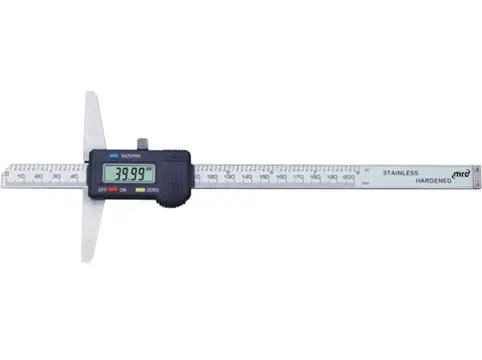
Digital Depth Gauges are an upgrade from their analog ancestors and are all about precision, convenience, and speed. Whether you're drilling a hole, checking groove depth, or maintaining machine parts—knowing how digital depth gauges work can really up your game.
The Concept of Depth in Engineering and Manufacturing
Depth isn't just how "deep" something goes—it's about consistency, tolerance, and accuracy. In mechanical design or production, even a 0.01mm error can mean failure. Measuring depth correctly is crucial in engineering and manufacturing environments.
Analog vs. Digital Depth Gauges
Analog Depth Gauges (like vernier or dial models) have been used for decades. But they require skilled reading, which leaves room for human error. Digital depth gauges, on the other hand, give you an exact numerical readout—no guesswork, just results.
Components of a Digital Depth Gauge
Probe or Measuring Rod
This is the part that actually makes contact with the surface you're measuring from. It moves up and down, and its position is what gets measured.
Digital Display
This is the magic part—no squinting needed. The LCD screen shows you the depth instantly, often with options for mm/inch and zeroing out.
Base or Foot
The flat surface that sits against your reference surface, ensuring stability and perpendicularity during measurement.
Internal Sensors and Circuitry
Inside, a linear encoder translates the rod’s position into a digital signal. It’s like the brain of the operation—measuring tiny changes in position and converting them to numbers you can use.
Power Source (Battery/Lithium Cell)
Most models are battery-powered, typically using coin cell batteries that can last months or even years depending on usage.
How Digital Depth Gauges Work
Step-by-Step Breakdown of the Working Mechanism
- You place the base on a flat reference surface.
- Lower the probe into the hole or recess.
- The probe’s movement triggers the internal encoder.
- The encoder translates this into a digital signal.
- The display shows the result in real-time.
The Role of Linear Encoders
A linear encoder is a sensor that converts linear displacement into an electrical signal. It works based on magnetic, optical, or capacitive sensing, depending on the model.
How Digital Signals Are Converted and Displayed
The internal microcontroller takes the encoder's signal, processes it, and pushes it to the screen. It’s basically a tiny computer doing math in milliseconds.
Key Features and Specifications
Measuring Range
Ranges typically go from 0-150mm, 0-200mm, up to 300mm or more.
Accuracy and Resolution
Most provide accuracy up to ±0.02mm with resolution as fine as 0.01mm.
Data Output and Connectivity
High-end models offer USB, Bluetooth, or wireless connectivity for data logging and integration into quality control software.
Applications of Digital Depth Gauges
Industrial Use
From aerospace to heavy machinery, they ensure tight tolerance checks.
Automotive Applications
Used to check brake pad wear, bore depth, and more.
Metalworking and Tooling
Ensures precision in die cutting, mold making, and CNC operations.
Construction and Civil Engineering
Useful in tasks like foundation inspection and concrete core depth checks.
Benefits of Using Digital Depth Gauges
Precision and Reliability
Digital means less chance for human error.
Ease of Use and Readability
Clear displays and often one-touch zeroing make life easier.
Time Efficiency
Measure, record, repeat. Simple.
Data Logging and Integration
With wireless models, you can log hundreds of readings instantly.
Buying Guide
What to Look for in a Digital Depth Gauge
- Resolution
- Material (stainless steel is king)
- Output capability
- Brand reputation
Tips for Accurate Measurements
- Zeroing Before Use
- Always set your gauge to zero before the first read.
- Holding Techniques
- Hold perpendicular to avoid skewed results.
- Avoiding Measurement Errors
- Clean surfaces and steady hands—that’s the key.