Spray drying has quietly become one of the most powerful technologies in pharmaceutical and biotechnology manufacturing.
What Is a Spray Dryer
A spray dryer is a system that converts liquid solutions, suspensions, or emulsions into dry particles by atomizing them into a hot drying gas. The droplets dry almost instantly while suspended in air, leaving behind fine powders that are collected downstream.
Why Spray Drying Matters in Pharma and Biotech
Pharmaceuticals and biotechnology products are often sensitive to moisture, heat, and oxygen. Spray drying helps overcome these issues by:
- Locking active ingredients into solid form
- Improving shelf life
- Enabling precise dose control
- Making drugs easier to formulate into tablets, capsules, or inhalers
In short, it is the bridge between liquid science and solid medicine.
The Science Behind Spray Drying
Spray drying is a dance between fluid mechanics, heat transfer, and particle engineering. Every parameter matters.
Atomization Process
Atomization breaks the liquid feed into millions of tiny droplets. Smaller droplets dry faster, while larger ones create denser particles.
Nozzle Atomizers
Pressure or two fluid nozzles are widely used in pharmaceutical spray dryers. They offer tight control over droplet size and are well suited for sterile or contained environments.
Rotary Atomizers
Rotary disks spin at high speed to fling liquid outward into droplets. These are common in large scale systems where high throughput is required.
Drying Chamber Dynamics
Once atomized, droplets enter a drying chamber filled with hot air or nitrogen. The solvent evaporates almost instantly, forming solid particles that fall to the bottom or are swept into cyclones for collection.
Particle Formation Mechanisms
Particles can form as hollow spheres, dense granules, or porous shells depending on:
- Solvent volatility
- Solids concentration
- Drying temperature
- Residence time
These structures directly influence dissolution rate and stability.
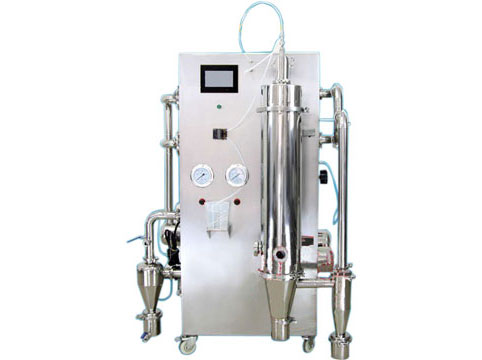
Core Components of a Pharmaceutical Spray Dryer
A pharma grade spray dryer is far more than a heated box with a nozzle.
Feed Pumping System
High precision pumps deliver a consistent flow of liquid feed. Even tiny fluctuations can change particle size or moisture content.
Heating and Airflow Units
Inlet air heaters, blowers, and flow controllers define how quickly droplets dry. Closed loop systems may replace air with nitrogen when solvents are flammable.
Cyclone Separators and Filters
Cyclones spin the air stream to separate powder, while HEPA filters prevent contamination and protect operators.
Control Panels and Automation
Modern systems rely on programmable logic controllers, sensors, and real time analytics to maintain reproducibility batch after batch.
Why the Pharmaceutical Industry Relies on Spray Dryers
Spray drying is not just convenient. It solves some of the toughest formulation problems.
Stability Enhancement
Amorphous dispersions created by spray drying can stabilize poorly soluble drugs, preventing crystallization and degradation.
Improved Bioavailability
By engineering small, porous particles with high surface area, drugs dissolve faster in the body, boosting absorption.
Controlled Particle Engineering
Need particles that flow into capsules but aerosolize in lungs? Spray drying can do both by tuning operating conditions.
Applications in Pharmaceutical Manufacturing
Spray dryers appear at nearly every stage of modern drug development.
Dry Powder Inhalers
Respiratory drugs depend on particles in the one to five micron range. Spray drying delivers these with remarkable consistency.
Tablet and Capsule Formulations
Powders produced by spray dryers blend easily with excipients, compress well, and maintain uniform potency.
Amorphous Solid Dispersions
Poorly soluble drugs are often embedded in polymer matrices using spray drying to boost dissolution rates dramatically.
Vaccine and Adjuvant Processing
Spray dried vaccines can sometimes be stored without refrigeration, opening doors for global distribution in remote regions.
Spray Drying in Biotechnology
Biotech products tend to be fragile, making spray drying both challenging and invaluable.
Enzymes and Proteins
With the right stabilizers and mild temperatures, enzymes can survive spray drying and remain active in powdered form.
Probiotics and Live Cultures
Some microorganisms can be encapsulated and dried while retaining viability, especially when protective sugars are used.
Cell Free Biologics
Growth factors, antibodies, and peptides benefit from spray drying when long term storage is required.
Diagnostic Reagents
Powdered reagents for test kits last longer and ship more easily than liquid counterparts.
Particle Engineering and Morphology Control
This is where spray drying becomes an art form.
Size Distribution Control
By adjusting nozzle type, feed rate, and air temperature, operators can dial in particle sizes from sub micron to hundreds of microns.
Density and Porosity
Low density particles improve aerosolization, while dense ones flow better into tablets. Both are achievable.
Surface Chemistry
Coatings and excipients can migrate to particle surfaces during drying, influencing wettability and stability.
Solvent Handling and Safety Considerations
Pharmaceutical spray drying often involves organic solvents, which raises the stakes.
Organic Solvents in Pharma
Ethanol, acetone, and dichloromethane appear frequently in drug formulations and must be handled carefully.
Explosion Protection
Spark free designs, grounding, and pressure relief panels are standard in compliant systems.
Nitrogen Closed Loop Systems
Replacing air with nitrogen minimizes fire risk and allows solvent vapors to be condensed and recovered.
Who Needs a Spray Dryer in Pharmaceuticals and Biotechnology?
1. Pharmaceutical R&D Teams
Who: Formulation scientists, process development chemists, preclinical researchers.
Why they use it:
- Convert drug solutions or suspensions into solid dosage forms.
- Improve solubility of poorly water soluble APIs through amorphous dispersions.
- Create inhalable powders for pulmonary delivery.
- Screen excipient combinations quickly at lab scale.
Typical outputs:
- Dry powders for capsules or tablets.
- Spray dried dispersions (SDDs).
- Prototype dry powder inhaler formulations.
2. Biotech Researchers and Protein Scientists
Who: Bioprocess engineers, protein chemists, vaccine developers.
Why they use it:
- Stabilize enzymes, antibodies, peptides, or vaccines.
- Produce dry intermediates for storage or transport.
- Replace freeze drying when rapid processing is needed.
Typical outputs:
- Enzyme powders.
- Vaccine excipient blends.
- Dried microbial metabolites.
3. Drug Manufacturing and CDMOs
Who: Pharmaceutical manufacturers and contract development and manufacturing organizations.
Why they use it:
- Scale formulations from pilot to production.
- Manufacture amorphous solid dispersions.
- Produce uniform granules for downstream tableting.
- Dry heat sensitive compounds with short residence times.
Typical outputs:
- API intermediates.
- Inhalation grade powders.
- Modified release carriers.
4. Inhalation Product Developers
Who: Pulmonary drug delivery specialists.
Why they use it:
- Precisely control aerodynamic particle size (1 to 5 microns).
- Produce carrier free inhalable powders.
- Enhance lung deposition efficiency.
Typical outputs:
- DPI formulations for asthma, COPD, or systemic delivery.
5. Vaccine and Biologic Manufacturers
Who: Companies developing mRNA vaccines, viral vectors, recombinant proteins.
Why they use it:
- Convert liquid vaccines into thermostable dry forms.
- Reduce cold chain dependency.
- Enable alternative delivery systems such as nasal powders.
Typical outputs:
- Spray dried vaccine bulks.
- Dry adjuvant formulations.
6. Clinical Trial Supply Units
Who: GMP pilot plants and clinical manufacturing groups.
Why they use it:
- Prepare small GMP compliant batches.
- Rapidly modify formulations between trial phases.
- Produce blinded placebo and active materials.
Typical outputs:
- Phase I and II investigational products.
- Stability study samples.
7. Quality Control and Analytical Labs
Who: Pharmaceutical QC laboratories.
Why they use it:
- Prepare uniform reference materials.
- Produce powders for dissolution or stability testing.
- Evaluate batch to batch drying behavior.
Typical outputs:
- Standardized test powders.
- Stress tested samples.
Key Advantages Driving Adoption
Spray dryers are chosen in pharma and biotech because they deliver:
- Rapid drying with minimal thermal exposure.
- Narrow particle size distribution.
- Scalable process from milligrams to tons.
- Compatibility with solvents and aqueous systems.
- Ability to generate amorphous or crystalline structures.
- Continuous production at manufacturing scale.