These systems are among the most efficient and widely used separation technologies in manufacturing plants, wastewater treatment facilities, food processing operations, pharmaceutical production, and chemical industries. Instead of waiting hours or even days for particles to settle naturally, centrifuges use powerful rotational forces to accelerate separation, often completing the process within minutes or seconds.
The demand for advanced separation systems continues to grow as industries seek greater productivity, lower operating costs, and improved resource efficiency. Centrifuge technology helps achieve all of these goals simultaneously. It enhances product quality, optimizes manufacturing processes, and provides better control over production outcomes. In many industries, achieving the required purity, cleanliness, and process efficiency would be nearly impossible without a reliable centrifuge system.
What Is a Centrifuge and How Does It Work?
A centrifuge is a mechanical device that operates by rotating at extremely high speeds. During operation, centrifugal force acts on the materials inside the machine. When a mixture containing solids and liquids enters the centrifuge, the denser solid particles move toward the outer wall of the rotating bowl, while the liquid phase remains closer to the center. This creates a rapid and highly efficient separation process between the different components of the mixture.
One of the greatest advantages of a centrifuge over traditional separation methods is speed. Rather than relying solely on gravity, a centrifuge can generate forces thousands of times greater than gravitational acceleration. Industrial decanter centrifuges, for example, may reach forces of several thousand Gs, dramatically accelerating sedimentation and improving separation performance. This capability allows industries to process large volumes of material quickly while maintaining consistent product quality.
The Physical Principle Behind Centrifugal Force
A simple way to understand centrifugal force is to imagine a spinning amusement ride. As the ride rotates faster, passengers feel pushed outward. The same principle applies inside a centrifuge. Heavier and denser particles experience stronger outward forces and migrate toward the bowl wall more rapidly than lighter materials. This difference in particle movement forms the basis of the separation process.
The effectiveness of separation depends on several factors, including rotational speed, particle size, liquid viscosity, and density differences between materials. By optimizing these variables, centrifuges can achieve exceptional separation performance even when handling very fine particles that would be difficult to separate using conventional methods.
How Solid-Liquid Separation Takes Place
When a mixture enters a centrifuge, it is directed into a rapidly rotating chamber. During rotation, solid particles begin migrating outward toward the bowl wall. Simultaneously, the clarified liquid remains closer to the center and is discharged separately. Depending on the centrifuge design, this process may operate continuously or in batch cycles.
Modern centrifuges allow operators to control numerous process parameters, including rotational speed, differential speed, residence time, and temperature. This flexibility enables the equipment to be customized for specific applications. Food processing operations, for example, require different operating conditions than municipal wastewater treatment facilities. The ability to fine-tune performance is one of the primary reasons centrifuges have become indispensable across a wide range of industries.
Factors Affecting Separation Efficiency
| Factor | Impact on Performance |
|---|
| Rotational Speed | Higher speeds generally improve separation efficiency |
| Particle Size | Larger particles separate more easily |
| Liquid Viscosity | More viscous liquids can reduce separation efficiency |
| Density Difference | Greater density differences improve separation |
| Residence Time | Longer residence times may enhance separation quality |
Types of Centrifuges for Solid-Liquid Separation
The centrifuge market includes a wide range of technologies, each designed for specific applications and process requirements. Selecting the appropriate centrifuge depends on factors such as throughput, particle characteristics, product quality requirements, and operational goals.
Decanter Centrifuges
Decanter centrifuges are among the most widely used solid-liquid separation systems in industry. They consist of a cylindrical-conical rotating bowl equipped with an internal screw conveyor. The conveyor rotates at a slightly different speed than the bowl, allowing separated solids to be continuously transported toward the discharge outlet.
A major advantage of decanter centrifuges is their ability to operate continuously. Solids are automatically discharged while the liquid phase continues flowing through the system. This design supports high processing capacities, minimizes labor requirements, and maximizes productivity. Decanter centrifuges are widely used in wastewater treatment, food processing, chemical manufacturing, and oil recovery applications.
Basket Centrifuges
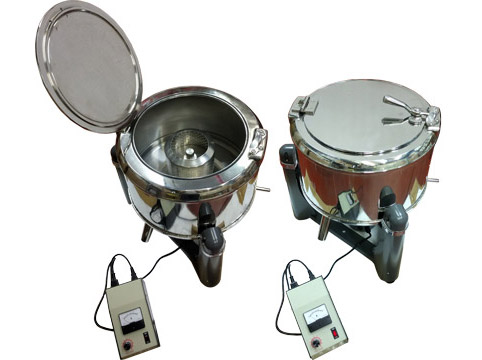
Basket centrifuges are particularly suitable for applications involving large quantities of solids. These systems utilize a perforated basket that allows liquids to pass through while retaining solid materials. Many industrial basket centrifuges are manufactured from stainless steel and are designed to operate reliably in corrosive or demanding environments.
Pharmaceutical and chemical industries frequently use basket centrifuges for crystal separation, product drying, and filtration processes. Their precision and ability to preserve product quality make them an attractive choice for high-value manufacturing applications.
Disc Stack Centrifuges
Disc stack centrifuges contain a series of conical discs that significantly increase the available separation area. This design allows highly efficient separation even when dealing with extremely small particles or low solid concentrations. Disc centrifuges are commonly found in dairy processing, beverage production, biotechnology, and pharmaceutical manufacturing.
Their ability to achieve exceptional clarification performance has made them one of the preferred solutions for industries requiring high levels of product purity and consistency.
Key Industrial Applications
Centrifuges have become essential across numerous industries. As quality standards continue to rise, organizations increasingly rely on advanced separation technologies to maintain efficiency and meet regulatory requirements.
Food and Beverage Industry
Food manufacturers use centrifuges in the production of edible oils, fruit juices, dairy products, wine, coffee, and tea. These processes require gentle yet effective separation that preserves flavor, texture, and nutritional value. Centrifuges help remove unwanted solids, improve clarity, and ensure product consistency.
When consumers purchase a bottle of clear juice or a smooth dairy product, there is a strong possibility that centrifuge technology played a role in achieving the final appearance and quality. The ability to maintain consistent product characteristics has made centrifuges a cornerstone of modern food processing.
Wastewater and Sludge Treatment
One of the fastest-growing applications for centrifuge technology is wastewater treatment. Municipal and industrial treatment facilities generate large volumes of sludge that must be dewatered before disposal or further processing. Decanter centrifuges efficiently separate water from sludge, significantly reducing waste volume and disposal costs.
As environmental regulations become increasingly stringent, efficient sludge management has become a priority for many organizations. Centrifuges help reduce transportation costs, minimize environmental impact, and support water reuse initiatives.
Chemical and Pharmaceutical Industries
Chemical and pharmaceutical production often involves valuable materials that require precise separation. Centrifuges are widely used for crystal recovery, suspension clarification, active ingredient production, and contaminant removal. Their ability to provide consistent, high-quality separation makes them critical components of modern manufacturing facilities.
Many industry experts consider centrifuges to be the heart of the separation process in pharmaceutical production. Product quality, regulatory compliance, and manufacturing efficiency often depend directly on the performance of these systems.
Advantages of Using Centrifuges
The widespread adoption of centrifuge technology is driven by numerous operational benefits. One of the most significant advantages is the ability to perform rapid separation without frequent process interruptions. This results in higher productivity and greater operational efficiency.
Another major benefit is improved product quality. Effective separation produces cleaner liquids and drier solids, which can significantly increase product value and process efficiency. Modern centrifuges are also equipped with sophisticated automation and monitoring systems that provide real-time process control and performance optimization.
In addition, centrifuges reduce labor requirements, lower waste disposal costs, and improve overall resource utilization. These advantages make them an attractive investment for organizations seeking long-term operational improvements.
How to Choose the Right Centrifuge
Selecting the right centrifuge involves much more than simply determining processing capacity. Factors such as particle size distribution, material density, liquid viscosity, cleaning requirements, and regulatory standards must all be considered.
Many manufacturers recommend conducting laboratory-scale testing before investing in full-scale industrial equipment. These tests provide valuable information about how specific materials respond to centrifugal forces and help determine the most suitable technology. Proper equipment selection can prevent costly operational issues and maximize long-term performance.
Future Trends in Industrial Separation
The centrifuge industry is undergoing rapid technological advancement. Modern systems increasingly incorporate smart sensors, remote monitoring capabilities, advanced vibration analysis, and automated process optimization. Artificial intelligence and predictive maintenance technologies are also being integrated to reduce downtime and extend equipment lifespan.
Global demand for energy-efficient manufacturing is driving the development of centrifuges that consume less power while maintaining high separation performance. At the same time, manufacturers are introducing more compact systems capable of delivering superior results within smaller installation footprints. These innovations are expected to shape the future of industrial separation technology for years to come.
Frequently Asked Questions
What is a centrifuge for solid-liquid separation?
A centrifuge is a machine that uses centrifugal force to separate solid particles from liquids quickly and efficiently.
What is the difference between a decanter centrifuge and a basket centrifuge?
Decanter centrifuges are designed for continuous operation and high throughput, while basket centrifuges are commonly used for filtration and crystal separation applications.
Which industries use centrifuges?
Centrifuges are widely used in food processing, pharmaceuticals, biotechnology, chemical manufacturing, wastewater treatment, oil processing, and many other industries.
Do centrifuges reduce operating costs?
Yes. They improve process efficiency, reduce labor requirements, enhance resource recovery, and lower waste management costs.
How can I choose the right centrifuge?
Selection depends on factors such as material characteristics, particle size, processing capacity, cleanliness requirements, and specific application goals.
MRC provides a wide range of centrifuges for separating solids from liquids.
Video