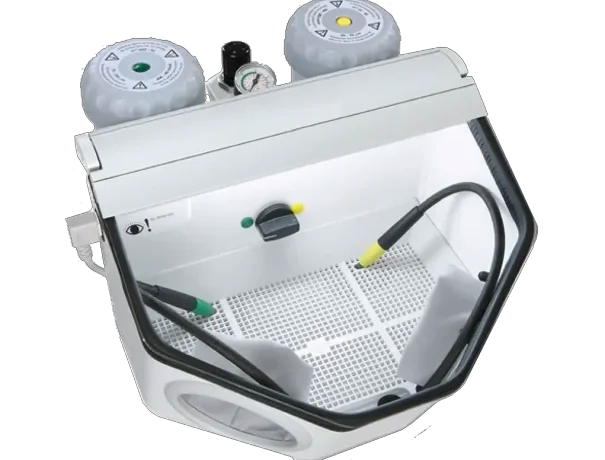
Our compact sandblasting cabinets give you full control over laboratory-scale surface processing: quick cleaning, fine roughening, rust/oxide removal, light engraving, and micro-etching – all without contaminating the lab or damaging the sample.
The sealed cabinet ensures a clean work environment, featuring internal lighting, integrated gloves, and a dust outlet for a dedicated vacuum.
How a Sandblasting Cabinet Works
Compressed air propels abrasive media (alumina, glass beads, SiC, soda, or fine organic media) through a precision nozzle and directs it onto the surface. The controlled impact removes foreign layers, gently roughens, or cleans grooves – depending on pressure, particle size, and distance. Two technologies are available:
-
Suction/Venturi – lightweight and economical, ideal for fine media and delicate work.
-
Pressure – powerful and fast, best for high removal rates or coarser abrasives.
Typical Applications of Sandblasting Cabinets
-
Surface preparation before bonding, coating, or printing (adhesion promotion)
-
Removal of oxides and oxide scale from metal parts and tools
-
Metallography: focused cleaning prior to embedding or polishing
-
Dental laboratories: micro-etching of crowns and molds
-
Electronics/PCB: stripping delicate masks/coatings, light etching
-
Additive manufacturing/3D printing: removal of powder and chips from printed parts
-
Glass, ceramics, and polymers: matte finishing, marking, and light engraving
Why It’s Ideal for Laboratory Use
The unit is compact and benchtop-friendly, with low air consumption, quick media change, and an integrated filter/vacuum that keeps the workspace clean. You can precisely adjust the level of delicacy by selecting pressure (≈2–7 bar), grain size (typically 50–250 µm), and nozzle diameter.
Safety and Operation
Equipped with a tempered observation window, internal lighting, durable gloves, and dust/HEPA extraction ports. Safety glasses are recommended when loading media, and a filter should be used for fine dust collection.