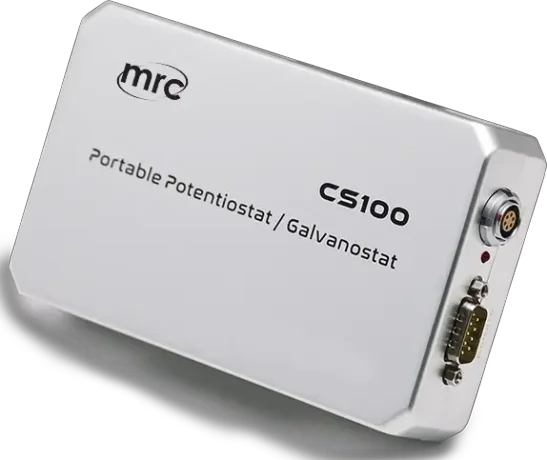
A potentiostat is an advanced electrochemical measuring and control instrument used for research, development, quality testing and characterization of processes involving electrochemical reactions between an electrode, solution, material, coating or energy system. It is one of the key instruments used in electrochemistry laboratories, corrosion research, energy research, advanced materials, sensors, water quality testing, batteries, fuel cells, coatings and academic research.
A potentiostat enables precise control of the electrical potential applied to an electrochemical system and measures the current generated as a result of the reaction. By accurately controlling the voltage and analyzing the resulting current, it is possible to understand how a material behaves under different conditions, how resistant it is to corrosion, how an electrode reacts in a solution, how effective a protective coating is, how a battery charges and discharges, or how an electrochemical sensor performs in detecting pollutants, heavy metals or active substances.
In many cases, the potentiostat is also combined with a galvanostat function, which enables current control and voltage measurement, as well as with EIS capabilities, meaning Electrochemical Impedance Spectroscopy, for measuring electrochemical impedance. This combination turns the instrument into a broad electrochemical workstation capable of performing a wide range of advanced testing methods such as CV, LSV, Tafel, OCP, CA, CP, GCD, EIS, Mott-Schottky, polarization measurements and more. The models in this category include capabilities such as Potentiostat / Galvanostat / EIS, wide current ranges, high accuracy, current resolution down to 1pA and advanced frequency ranges for EIS testing.
What Is a Potentiostat and What Is Its Purpose?
The essence of a potentiostat is precise control of an electrochemical system. The instrument is usually connected to a system of two, three or four electrodes, depending on the type of test and the required level of accuracy. In a common three-electrode configuration, the system includes a working electrode, a reference electrode and a counter electrode. The potentiostat controls the potential of the working electrode relative to the reference electrode, while simultaneously measuring the current flowing through the system.
The collected data makes it possible to understand chemical and physical processes occurring on the surface of the electrode or inside the tested material. Therefore, a potentiostat is not just a standard measuring instrument, but a research tool that enables characterization of mechanisms, comparison of materials, stability testing, fault detection, measurement of oxidation-reduction reactions and evaluation of electrochemical system performance in real time.
In practice, a potentiostat is used when a scientific or engineering answer is required to questions such as: Is a certain metal sensitive to corrosion? Does a protective coating actually reduce ion penetration? What is the capacity of a battery? Can a sensor detect a pollutant at low concentration? Is an electrode material suitable for fuel cells or supercapacitors? How does the system resistance change at different frequencies? These questions require accurate measurement of voltage, current, time and often impedance, making the potentiostat a central tool in these fields.
Main Applications of Potentiostats
Potentiostats are used in a wide range of scientific and industrial applications. These include corrosion research, coating tests, EIS testing, battery research, supercapacitors, fuel cells, electrocatalysis, electrochemical sensors, biosensors, water testing, heavy metal detection, glove box applications and portable field measurements.
Corrosion Research and Corrosion Protection
One of the most important applications of a potentiostat is corrosion testing. Using polarization measurements, Tafel analysis, OCP and EIS, it is possible to evaluate the corrosion rate of metals, the resistance of alloys and the effect of coatings, membranes and protective materials. These tests are important in fields such as the metal industry, infrastructure, bridges, buildings, marine systems, the chemical industry, reinforced concrete, piping, aerospace components, automotive applications and industrial equipment.
A potentiostat makes it possible to compare different materials and examine under which conditions corrosion develops. For example, steel, stainless steel, titanium, aluminum and various coatings can be tested in salt solutions, acidic environments or test conditions that simulate real field conditions. When a deeper characterization of a protective layer or coating is required, EIS testing can identify processes that are not visible in a simple measurement, such as electrolyte penetration, reduced coating resistance or changes at the interface between the coating and the metal.
Batteries, Supercapacitors and Fuel Cells
A potentiostat with a galvanostat function is used for research and development of energy storage systems, including lithium batteries, supercapacitors and fuel cells. These tests often require current control, voltage measurement over time, charge and discharge cycles, cyclic stability testing, capacity characterization, coulombic efficiency evaluation and comparison between different electrode materials.
The models in this category include capabilities suitable for energy research, including wide current ranges, GCD, EIS, CV and additional methods. For example, the CS350M model is presented as an advanced single-channel electrochemical workstation with more than 40 techniques, including EIS, CV, LSV, GCD, Tafel, OCP, CA and CP, with a maximum current of ±2A and the option to expand with a booster for higher currents.
Electrocatalysis and Energy Materials
In the field of renewable energy and electrochemical catalysis, a potentiostat is used to test materials intended for reactions such as HER, OER, ORR and CO₂ reduction. These are central reactions in the development of fuel cells, hydrogen production, electrolysis, energy storage systems and technologies for reducing carbon emissions.
The ability to measure low currents, monitor reactions in real time and perform accurate potential scans enables researchers to compare catalysts, test stability, calculate electrochemical activity and identify whether a specific material is suitable for further development. In research laboratories, a potentiostat is a basic tool for evaluating electrodes, nanomaterials, porous materials, ionic conductors, metal oxides and carbon-based materials.
Electrochemical Sensors and Biosensors
A potentiostat is also used for the development and testing of electrochemical sensors and biosensors. These sensors are designed to measure substances at low concentrations, sometimes at trace levels, in solutions, water, food, biological samples or industrial processes. The portable model page includes applications such as sensor development, biosensors, analysis of heavy metals in water and detection of Pb²⁺, Cd²⁺ and Zn²⁺ ions using stripping voltammetry methods.
In this field, it is especially important to choose an instrument with high current resolution, low noise and the ability to measure very low currents. When the electrical signal is small, the quality of the instrument directly affects the quality of the measurement, the detection limit and the reliability of the results. Therefore, a potentiostat is suitable for laboratories working in water quality, environmental monitoring, food testing, pharmaceutical research, pollutant testing and advanced sensor development.
Water Quality Testing and Environmental Monitoring
In water quality and environmental applications, a potentiostat enables the measurement of pollutants, ions and heavy metals, as well as the development of methods for detecting substances at low concentrations. The instrument is suitable for monitoring laboratories, environmental organizations, research institutions, authorities, water companies, the chemical industry and laboratories involved in testing pollutants in water, soil or wastewater.
The advantage of electrochemical measurement is the ability to obtain a fast, sensitive and sometimes portable response. In cases where measurements must be performed outside the laboratory, a portable model such as the CS100ME is especially suitable, since it is designed for field measurements, operation without a power connection, field corrosion testing and work inside a glove box.
Types of Potentiostats in the Category
The potentiostat category includes several models designed for different levels of use: portable measurements, general research, advanced measurements with EIS and systems with higher current or frequency ranges.
CS100ME Portable Potentiostat
The CS100ME is a portable potentiostat / galvanostat designed for polarization applications and electrochemical measurements in the field and in the laboratory. The product page indicates suitability for corrosion research, polarization curves, EIS testing, corrosion testing in bridges, soil and structures, coating tests, batteries, supercapacitors, fuel cells, electrochemical sensors, biosensors, water quality and glove box applications.
The main advantage of a portable instrument is the ability to perform testing close to the actual system, without having to transfer samples to the laboratory. This is especially important when testing infrastructure, bridges, buildings, large metal systems, industrial facilities, piping or environments where field conditions affect the result. In addition, a portable instrument is suitable for laboratories that need flexibility, temporary testing, outdoor measurements or use inside glove boxes and closed systems.
CS1350Pro Potentiostat / Galvanostat / EIS
The CS1350Pro is an electrochemical workstation with a maximum current of ±5A without the need for a booster, according to the product information. The model includes a current range of ±2nA to ±5A, applied potential of ±10V, compliance voltage of ±18V, built-in EIS/FRA from 10μHz to 1MHz, voltage and current accuracy of 0.1% of range, voltage resolution of 10μV and current resolution of 1pA.
This model is especially suitable for laboratories that require relatively high current in an independent instrument, without an external amplifier. It is suitable for research where the currents are not only low, but where operation is also required in systems with more significant current consumption, such as large electrodes, certain test cells, batteries, electrolysis, energy processes and materials requiring a wide operating range.
CS350M Potentiostat / Galvanostat with EIS
The CS350M is presented as an advanced single-channel electrochemical workstation that includes more than 40 techniques, including EIS, CV, LSV, GCD, Tafel, OCP, CA, CP, i-v, i-t and E-t. The model includes Potentiostat / Galvanostat / FRA / ZRA, a maximum current of ±2A, a current range of ±2nA to 2A, applied potential of ±10V with an optional adjustment to ±12V, compliance voltage of ±21V, built-in EIS/FRA from 10μHz to 1MHz, accuracy of 0.1% of range, voltage resolution of 10μV and current resolution of 1pA.
This model is suitable for research laboratories that need a versatile instrument covering many electrochemical techniques. It is suitable for materials research, corrosion, coatings, sensors, batteries, supercapacitors, fuel cells and applications that require high flexibility in selecting the measurement method.
CS350Pro Potentiostat / Galvanostat / EIS 5MHz
The CS350Pro is an advanced version of the CS350M, with EIS capability up to 5MHz. According to the product page, the model includes a maximum current of ±2A, a current range of ±200fA to 2A, applied potential of ±10V, compliance voltage of ±30V, built-in EIS/FRA from 10μHz to 5MHz, voltage and current accuracy of 0.1% of range, voltage resolution of 10μV and current resolution of 1pA.
This model is especially suitable for laboratories that require advanced impedance measurements at high frequencies, higher sensitivity at low currents and a wide measurement range. It can be suitable for advanced research of coatings, membranes, high-resistance systems, electrochemical materials, sensors, biomaterials, energy systems and research in which analyzing system behavior at different frequencies is a central part of the test.
What Is the Difference Between a Potentiostat and a Galvanostat?
A potentiostat and a galvanostat are two different control modes in the same electrochemical system. In potentiostat mode, the instrument controls the voltage and measures the resulting current. This mode is especially suitable for potential scans, voltammetric measurements, corrosion testing, polarization measurements and research of oxidation-reduction reactions.
In galvanostat mode, the instrument controls the current and measures the voltage. This mode is especially important in charge and discharge testing of batteries, supercapacitors, electrolysis processes and studies in which a constant current is applied and the system response is evaluated over time.
When one instrument includes both Potentiostat and Galvanostat functions, it provides greater flexibility and enables a wider range of tests. For this reason, many research laboratories choose an electrochemical workstation that combines both functions, often together with EIS.
What Is EIS Testing and Why Is It Important?
EIS, or Electrochemical Impedance Spectroscopy, is an advanced method for measuring the response of an electrochemical system at different frequencies. Instead of measuring only voltage and current at a given moment, EIS allows examination of how the system responds to an electrical signal that changes across low and high frequencies. This provides deeper information about resistance, capacitance, charge transfer, diffusion, protective layers, membranes, coatings and processes occurring at the interface between the electrode and the solution.
In corrosion testing, EIS can help identify a decline in coating quality before visible failure appears. In battery testing, it can help understand internal resistance, aging and ion transfer processes. In sensors, it can be used to characterize active layers and biological or chemical interfaces. The category models include EIS ranges of 10μHz to 1MHz in the CS1350Pro and CS350M models, and up to 5MHz in the CS350Pro model.
Who Uses Potentiostats?
Potentiostats are intended for a wide range of professional users, including:
Research laboratories at universities, research institutes, electrochemistry laboratories, materials laboratories, corrosion laboratories, energy laboratories, companies developing batteries and fuel cells, coating companies, metal industries, the chemical industry, water quality laboratories, environmental monitoring bodies, pharmaceutical companies, food laboratories, biotechnology companies, sensor manufacturers, materials engineers, nanomaterials researchers and quality control laboratories.
Choosing the right instrument depends on the type of measurement, the required current and voltage ranges, the need for EIS, the number of required electrochemical methods, measurement sensitivity, sample type, the need for portability and whether the application is basic research, product development, field testing or quality control.
How to Choose a Suitable Potentiostat
Selecting a potentiostat should be based on several professional parameters:
Current Range
It is important to check the expected current range in the measurement. Sensors, biosensors and trace-level measurements require the ability to measure very low currents. In contrast, batteries, electrolysis and cells with a large electrode surface area may require higher currents. For example, the CS1350Pro offers a maximum current of ±5A, while the CS350M and CS350Pro offer a maximum current of ±2A according to the product specifications.
Need for EIS
If the work includes coatings, membranes, corrosion, batteries, fuel cells, porous materials or systems where it is important to understand behavior at different frequencies, it is recommended to choose an instrument with built-in EIS. When an especially high frequency range is required, a model such as the CS350Pro with EIS up to 5MHz may be more suitable.
Portability
When field testing is required, including testing on structures, bridges, soil, piping, industrial facilities or operation without a power connection, a portable potentiostat such as the CS100ME should be considered. The product page notes that it is suitable for portable field measurements and applications such as corrosion testing in bridges, soil and structures.
Range of Measurement Methods
In research laboratories, it is important to choose an instrument that supports many electrochemical methods. For example, the CS350M is presented as an instrument with more than 40 techniques, including CV, LSV, GCD, Tafel, OCP, CA, CP and EIS.
Accuracy and Resolution
In electrochemical measurements, especially when currents are low, current resolution and accuracy are very important. The CS1350Pro, CS350M and CS350Pro models specify current resolution of 1pA and voltage resolution of 10μV, which are suitable for accurate laboratory measurements.
Research and Industrial Fields That Use Potentiostats
A potentiostat is suitable for research and development in many fields.
In corrosion, it is used to evaluate the resistance of metals and coatings. In energy, it is used for battery, supercapacitor, fuel cell and electrolysis research. In sensors, it is used for the development of electrochemical sensors and biosensors. In environmental quality, it enables measurement of pollutants and heavy metals in water. In materials science, it is used to characterize nanomaterials, membranes, ionic conductors and electrocatalytic materials. In pharmaceutical and food applications, it can be used to identify active substances, monitor reactions and perform various analytical tests.
The combination of voltage control, current control, impedance measurement and the ability to perform advanced electrochemical methods makes the potentiostat an essential working tool in laboratories where a deep understanding of material behavior and electrochemical systems is required.