Liquid handling workstations are designed to perform accurate, fast, and repeatable operations such as liquid transfer, sample dispensing, reagent dosing, mixing, dilution, and sample preparation for laboratory testing and research processes. These systems provide an efficient solution for laboratories that handle large numbers of samples, small to medium liquid volumes, microtiter plates, tubes, reagents, and various solutions.
In manual laboratory work, repetitive pipetting tasks can take a significant amount of time, create workload for laboratory staff, and increase the risk of human error. Liquid handling workstations allow these operations to be performed automatically or semi-automatically, while maintaining accuracy, consistency, and high repeatability between samples. As a result, they help improve process quality, shorten working time, and increase laboratory throughput.
What Is a Liquid Handling Workstation?
A liquid handling workstation is an advanced laboratory system designed for controlled handling of liquids and samples. The system can perform operations such as aspiration, transfer, dispensing, mixing, dilution, and arrangement of liquids between tubes, plates, containers, or other laboratory vessels. Some systems support multi-channel operation, for example, working with 96-well plates, allowing a large number of tasks to be completed quickly and accurately.
These workstations are especially suitable for laboratories that require repetitive processes, small-volume handling, preparation of sample series, high-volume testing, or work according to fixed protocols.
Advantages of Liquid Handling Workstations
Using liquid handling workstations provides several important advantages for the laboratory. The first is improved accuracy and repeatability. When the same operation is performed automatically according to a fixed protocol, higher consistency is achieved between samples compared with manual work, which depends on the user’s skill.
Another key advantage is significant time savings. Tasks such as reagent dispensing, sample transfer, or plate preparation can be performed much faster, especially when working with dozens or hundreds of samples. In addition, automating these processes reduces the workload on laboratory staff and allows them to focus on more complex professional tasks.
Liquid handling workstations also help reduce human errors, such as transferring the wrong volume, skipping a sample, inconsistent mixing, or lack of consistency between tests. In laboratories where result reliability is critical, this is a major advantage.
Common Laboratory Applications
Liquid handling workstations are suitable for a wide range of applications in research, biology, chemistry, diagnostics, and pharmaceutical laboratories. Common applications include sample preparation for PCR and qPCR, plate preparation for ELISA tests, reagent dispensing, serial dilution, work with 96-well plates, sample preparation for genetic research, liquid handling in screening processes, and routine work with large numbers of samples.
In addition, supporting systems such as automatic tube cap opening and closing machines help improve efficiency in workflows that require repeated handling of many tubes. These solutions contribute to a smoother workflow, reduced manual contact, and improved safety and organization in the laboratory.
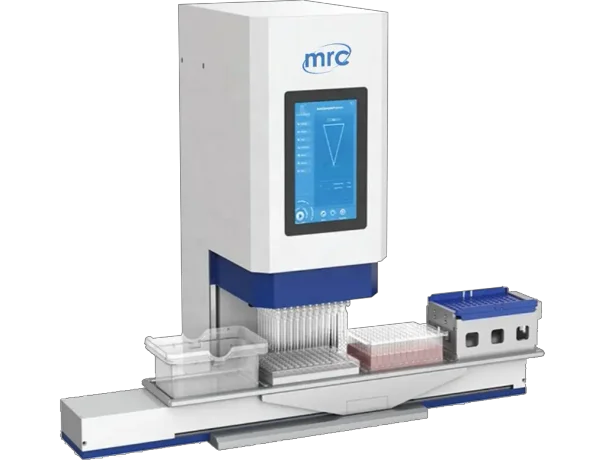
Who Are Liquid Handling Workstations Suitable For?
Liquid handling workstations are suitable for research laboratories, clinical laboratories, molecular biology laboratories, diagnostic laboratories, pharmaceutical laboratories, university laboratories, medical centers, biotechnology companies, and quality control laboratories. They are especially suitable for laboratories that need to increase throughput, maintain consistent processes, reduce manual work, and improve result reliability.
Choosing the right workstation depends on the application, required volume range, number of samples, type of labware used, desired level of automation, and existing laboratory protocols. A suitable system can turn a long and complex manual process into a much faster, more accurate, and more efficient workflow.
An Efficient Solution for Accurate Liquid Handling
Liquid handling workstations are an important part of modern laboratories aiming to streamline processes, improve accuracy, and reduce repetitive manual work. By automating pipetting, dispensing, transfer, and sample preparation operations, laboratories can achieve more consistent results, save valuable working time, and improve the quality of their laboratory processes.
This category includes advanced solutions for handling liquids and samples, suitable for a wide range of applications in research, diagnostics, molecular biology, pharmaceutical laboratories, and quality control.