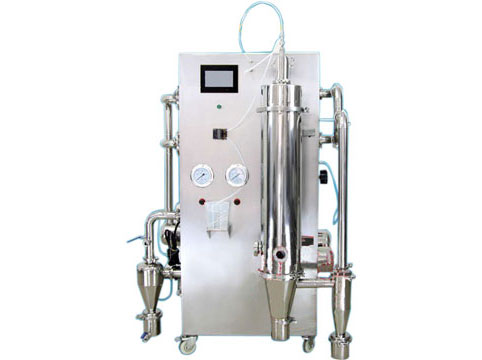
A spray dryer is an industrial system that converts liquids, slurries, emulsions, or extracts into dry powders by spraying them into a stream of hot air. The liquid instantly forms microscopic droplets, moisture evaporates in seconds, and dry particles fall to the bottom for collection.
Think of it like misting rain into a warm breeze and watching it vanish before it hits the ground. Only here, instead of disappearing, the droplets become perfectly engineered food powders.
How Spray Drying Works
Spray drying follows a beautifully choreographed three step process.
Atomization
Liquid feed enters the dryer through a nozzle or rotary atomizer. This breaks the stream into millions of tiny droplets. Smaller droplets dry faster, while larger ones form denser particles. Controlling droplet size is one of the keys to powder quality.
Drying Chamber
Hot air flows through the chamber and instantly evaporates moisture from the droplets. The temperature is high enough to remove water quickly but brief enough to protect flavors, aromas, and nutrients.
Powder Recovery
Cyclones or bag filters capture the dried particles, which are then cooled and packaged. The result is free flowing, shelf stable powder ready for blending or sale.
Why Spray Drying Is Critical for Food and Beverage Brands
Spray drying is not just convenient. It is transformative.
It helps manufacturers:
- Extend shelf life dramatically
- Reduce storage and shipping costs
- Create instant dissolve products
- Protect sensitive vitamins and aromas
- Produce uniform, attractive powders
- Improve dosing accuracy
In competitive markets where consistency matters, spray drying delivers repeatability batch after batch.
Key Components of a Food Grade Spray Dryer
Food grade spray dryers are engineered for hygiene, efficiency, and control. Core components include:
- Feed tank with agitation
- High pressure pump
- Atomizing nozzle or rotary disc
- Heated air supply system
- Drying chamber
- Cyclone separators
- Powder collection bins
- Cleaning in place systems
- Control panels with recipe management
Every surface touching product is typically stainless steel with smooth finishes to prevent microbial growth.
Types of Spray Dryers Used in Food Production
Different foods require different systems.
Tall Form Dryers
Large vertical chambers used for high volume dairy powders, infant formula, and whey proteins.
Compact Spray Dryers
Smaller footprint systems suitable for flavors, nutraceuticals, and specialty ingredients.
Multi Stage Systems
These integrate fluid beds inside or after the chamber to finish drying and agglomerate particles, producing instant powders with excellent solubility.
Common Food and Beverage Applications
Spray dryers appear across nearly every food category.
Dairy Powders
Milk, whey, caseinates, infant formula, and creamers rely heavily on spray drying to maintain nutrition and functionality.
Coffee and Tea Extracts
Liquid extracts become aromatic instant powders that rehydrate in seconds.
Flavorings and Seasonings
Encapsulated oils, spice blends, and savory bases benefit from controlled particle size and aroma retention.
Fruit and Vegetable Powders
Juices and purees are converted into colorful powders for smoothies, supplements, and bakery mixes.
Advantages Over Other Drying Technologies
Compared with tray drying, drum drying, or freeze drying, spray drying offers:
- Continuous processing
- High throughput
- Excellent control of particle properties
- Lower labor requirements
- Superior flowability
- Scalable design
- Consistent quality
Freeze drying may preserve structure better, but it is slower and far more expensive. Spray drying strikes the perfect balance between quality and economics.