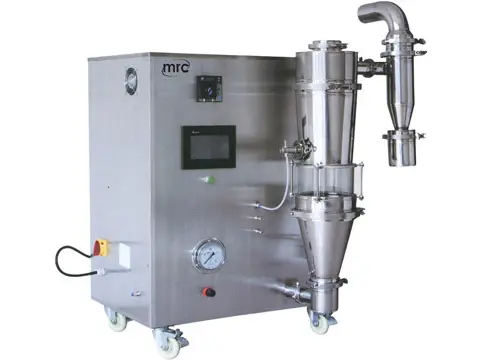
A lab spray granulator is a piece of equipment that transforms liquids or suspensions into granules by spraying them into a chamber with controlled airflow and temperature. It’s basically like freeze-drying’s fast, hot cousin—but instead of preserving, it builds granules.
Why Is It Used in Laboratory Settings?
Labs use spray granulators to test formulations, simulate production processes, and control particle characteristics before scaling up to industrial granulators. It’s the ideal bridge between theory and production.
Working Principle of a Spray Granulator
The process might seem complex, but at its heart, it’s all about physics and flow.
Atomization Process
The liquid is atomized into a fine mist using a high-speed nozzle. Think of spraying perfume—only more scientific and controlled.
Types of Nozzles
- Two-fluid nozzles (compressed air + liquid)
- Ultrasonic nozzles (vibrational atomization)
- Pressure nozzles (high pressure-driven)
Drying Mechanism
The sprayed droplets enter a chamber with hot air. The moisture quickly evaporates, leaving behind solid granules.
Granule Formation
As droplets dry mid-air, they shrink into granules with tightly controlled size and moisture content.
Key Components of a Lab Spray Granulator
Every part is important role in ensuring consistent and safe operation.
Spray Nozzle
Responsible for creating the mist. If it clogs, the whole process crashes.
Drying Chamber
The heated zone where magic happens—evaporation and granule formation.
Airflow System
Keeps droplets suspended just long enough to dry without overheating.
Collection System
Granules are gathered into a collector, usually a cyclone or container.
Applications of Lab Spray Granulators
These machines are used in more industries than you’d guess.
Pharmaceuticals
To create controlled-release tablets, encapsulated drugs, and powders.
Food and Nutrition
Perfect for making powdered flavors, enzymes, vitamins, and dairy products.
Chemicals
Used for creating catalysts, fine chemicals, and additives.
Ceramics and Materials Science
Granulates materials for sintering, ensuring uniform heat response.
Advantages of Using a Lab Spray Granulator
Why choose a spray granulator over other methods? Here’s why:
Precise Control Over Particle Size
Fine-tune your parameters to get the exact size distribution you want.
Uniform Granule Formation
No more clumps—every granule is nearly identical in size and shape.
Scalability for Production
Start small, think big. You can test in the lab and scale to production later.
Time and Cost Efficiency
It’s a fast process and saves money compared to other granulation techniques.
Tips for Optimal Operation
Want to keep it running smoothly? Follow these tips.
Temperature Settings
Too hot? You’ll burn the granules. Too cold? They won’t dry properly.
Feed Rate Adjustments
Balance is key. Overfeeding causes wet clumps; underfeeding wastes time.
Cleaning and Maintenance
Regular cleaning prevents cross-contamination and keeps nozzles unclogged.