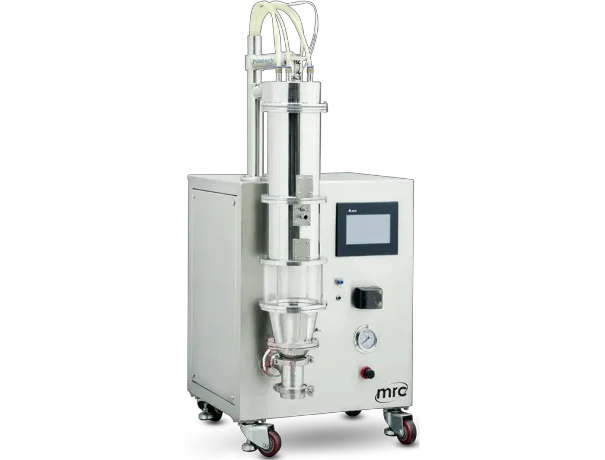
A fluid bed dryer (often shortened to FBD) dries wet powders, granules, crystals, or pellets by pushing heated air upward through the material so it behaves like a fluid. Instead of sitting in a static pile where heat has to crawl inward, the particles lift, separate, and mix. That mixing is the secret sauce: every particle gets frequent contact with hot air, so moisture leaves faster and more evenly.
If you have ever battled a tray dryer that gives you “dry on the edges, wet in the middle,” a fluid bed dryer feels like switching from a campfire to a modern oven with a fan. Same goal, totally different level of control.
What are uses of Fluid Bed Dryer
Fluid bed dryers are used to remove moisture from wet powders, crystals, granules, and pellets by suspending the material in an upward flow of heated air (fluidization). Common uses include:
- Drying pharmaceutical granules and powders after wet granulation (improves flow and compressibility for tablet/capsule production).
- Drying food ingredients such as starches, proteins, spices, instant products, and granulated additives while maintaining good texture and solubility.
- Drying chemical and mineral powders including salts, pigments, catalysts, detergents, and specialty chemicals.
- Drying agrochemical products like fertilizer granules and pesticide intermediates.
- Post-filtration or post-centrifuge drying of crystalline products (reducing residual moisture to a controlled level).
- Cooling or conditioning dried granules/powders (by switching to cooler air to stabilize the product before packaging).
Many fluid bed systems are also used for related operations (often in the same unit):
- Granulation (agglomeration): building larger, free-flowing granules from fine powders using a binder spray.
- Coating: applying functional or protective coatings (taste masking, controlled release, moisture barrier) to particles and pellets.
- Blending and mixing: gentle mixing during fluidization for more uniform product moisture and temperature.
The “Boiling Sand” Analogy
Picture sand in a container. If you blow air up from below, at some point the sand starts to dance and bubble like it’s boiling. That is fluidization. In a fluid bed dryer, your product plays the role of sand, and the air becomes the invisible spoon that keeps everything moving.
Why This Beats “Hot Air in a Box”
In a static bed, air tends to take the easiest path, so you get uneven heating and uneven drying. With fluidization, the bed becomes a mixing system. The air is not just heating the surface, it is constantly finding new surfaces to touch. The result is typically:
- Faster drying times
- More uniform residual moisture
- Better temperature control for heat-sensitive materials
The Core Principle: Fluidization Explained Simply
Fluidization happens when the upward force from the air flow balances the weight of the particles. Below that point, the bed is basically a packed pile. Above it, particles suspend and move.
Minimum Fluidization Velocity
There is a specific air velocity where the bed “just starts” to fluidize. This is the minimum fluidization velocity. You do not need to memorize equations to benefit from this concept. Operationally, it means:
- Too little airflow: the bed stays packed, dries unevenly, may overheat locally.
- Enough airflow: bed fluidizes, drying becomes efficient and uniform.
- Too much airflow: you may blow fines into filters, increase attrition, or even carry product out.
Pressure Drop and What It Tells You
Pressure drop across the bed is like a health monitor. As the bed fluidizes, pressure drop changes in a characteristic way. Operators often use it to detect:
- Channeling
- Filter issues
- Changes in bed density
- Overloading or underloading
Key Parts of a Fluid Bed Dryer
A fluid bed dryer is not complicated in concept, but it is picky about airflow and containment. The main components are designed to deliver air evenly, keep product where it belongs, and handle dust safely.
Air Handling and Heaters
This includes blowers or fans, heaters (electric, steam, gas), and sometimes dehumidification. Air quality matters more than people expect. Temperature, humidity, and cleanliness all directly affect drying time and final moisture.
Plenum, Distributor Plate, and Airflow Uniformity
The plenum is the air chamber under the product. The distributor plate (or screen) spreads air evenly. If distribution is uneven, you get channeling: air shoots through certain zones, while other zones sit wet and stagnant.
Product Bowl or Processing Chamber
This is where the material fluidizes. In pharma-style designs, the bowl is often removable and designed for cleaning. In industrial designs, you may see larger fixed chambers optimized for throughput.
Filters, Bags, and Fines Control
Fluidization creates dust. Filters and bag systems capture fines so they do not escape. Many machines include filter shaking or pulsing to knock dust back into the bed. If filters blind (clog), airflow drops and the entire process suffers.
How the Drying Process Works Step by Step
A typical batch process looks like this:
Loading and Pre-Checks
- Load wet material to a target bed depth.
- Confirm screens, gaskets, filters, and clamps are seated.
- Verify temperature sensors and airflow readings are responsive.
Ramp-Up, Fluidize, Dry, Cool, Discharge
- Ramp-Up: Start airflow and gently raise inlet temperature.
- Fluidize: Increase airflow to reach stable fluidization.
- Dry: Hold conditions while moisture is removed.
- Cool: Reduce inlet temperature or switch to ambient air to cool product.
- Discharge: Stop airflow, open discharge, transfer product.
This “dry then cool” step is not a luxury. If you discharge hot product into ambient humidity, it can reabsorb moisture like a sponge.
Fluid Bed Dryer Types
Different products behave differently, so fluid bed dryer designs have evolved into several flavors.
Batch Fluid Bed Dryers
Best when you need flexibility, frequent changeovers, and tight control. Common in pharmaceuticals and specialty chemicals.
Continuous Fluid Bed Dryers
Material enters at one end and exits at the other, moving through zones. These shine in high-throughput operations, especially when the product is consistent day after day.
Vibrated Fluid Beds
Vibration helps move material and improve fluidization for difficult particles. It can reduce channeling and help process slightly sticky or irregular products.
Spouted Beds
Instead of fluidizing the whole bed uniformly, air creates a central “spout” that circulates particles in a loop. Useful for larger particles and certain coating or drying challenges.
Common Applications Across Industries
Fluid bed drying is popular anywhere you need consistent moisture and gentle, controlled heat transfer.
Pharmaceuticals
Used to dry granules after wet granulation, and sometimes as part of integrated processes. Pharma operations focus heavily on uniformity, cleanliness, containment, and data integrity.
Food and Ingredients
Drying ingredients while preserving flavor and functionality can be tricky. Fluid beds help by keeping temperatures controlled and reducing hot spots that can scorch.
Chemicals and Polymers
Many chemicals crystallize wet, then need drying without melting, caking, or losing particle size distribution. Fluid beds can be tuned to avoid those problems when designed properly.
Minerals and Specialty Powders
High throughput, tough materials, and consistent final moisture are common requirements. Industrial fluid beds are often rugged and optimized for efficiency.
What Makes Fluid Bed Drying So Efficient
Two words: contact and mixing.
Heat Transfer and Mass Transfer Advantages
Drying is basically a trade: you supply heat to evaporate water, and you remove the vapor. In a fluid bed, the air constantly contacts fresh particle surfaces, so:
- Heat transfer is high because the boundary layer is constantly disrupted.
- Mass transfer is high because vapor does not sit and linger around a particle.
Uniform Drying and Gentle Handling
Because the bed mixes, moisture gradients are reduced. Many products dry more uniformly compared to static beds. With the right airflow, handling can also be gentler than aggressive mechanical mixing systems.
Critical Process Parameters You Must Control
This is where good drying becomes repeatable drying.
Inlet Air Temperature
Higher temperature can speed drying, but it can also cause:
- Surface crusting that traps moisture inside
- Melting or softening for sensitive materials
- Degradation for heat-labile compounds
A smart approach is often a staged temperature profile: higher early, lower later, with product temperature monitoring.
Airflow Rate
Airflow controls fluidization and the ability to carry away moisture. If drying slows unexpectedly, airflow and filters are prime suspects.
Bed Depth and Load Size
Too deep, and you risk poor mixing and dead zones. Too shallow, and you may blow product into filters. The “sweet spot” is product-specific and often needs trials.
Humidity and Dew Point
If your inlet air is humid, it has less capacity to absorb moisture. This is why drying can be slower in wet weather unless the system controls humidity.
Product Temperature
Product temperature is often more important than inlet temperature. The product sits near a wet-bulb-like condition early in the run, then rises as it dries. Watching that curve helps detect endpoints and prevent overheating.
Product Properties That Can Make or Break Performance
A fluid bed dryer is not magic. Some powders fight back.
Particle Size Distribution
Very fine powders can behave like smoke and load filters. Very large particles may need higher airflow or different designs. Wide distributions can cause segregation or uneven fluidization.
Moisture Binding and Hygroscopicity
Some materials hold water tightly or reabsorb it quickly. You may hit a point where drying slows dramatically because the remaining moisture is bound, not free.
Stickiness, Melting, and Glass Transition
If the product becomes sticky at process temperature, particles can clump, form lumps, and ruin fluidization. This is common with sugars, polymers, and some formulated blends. The fix is usually a combination of lower temperature, staged conditions, vibration, or formulation tweaks.
Quality and Endpoints
Drying is not finished when “it looks dry.” That is how you get batch-to-batch surprises.
Moisture Targets and Uniformity
Define:
- Average moisture specification
- Maximum allowed variation (uniformity)
- Sampling plan that actually represents the bed
In-Process Sampling
Sampling is tricky because the bed is dynamic. Pulling from one location can mislead you. A good approach is multiple samples over time and location, or validated sampling tools that reduce bias.
PAT Options Like NIR
Near-infrared (NIR) can estimate moisture in real time, which can reduce over-drying and improve consistency. It is not always trivial to calibrate, but for high-value products it can be worth it.