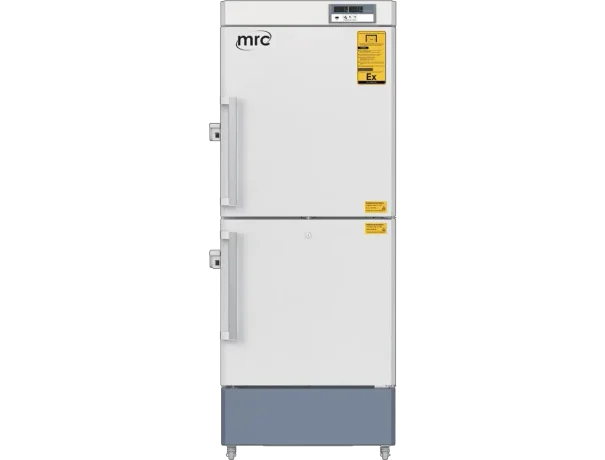
Laboratory explosion-proof refrigerators and freezers are cold-storage units engineered to prevent the refrigerator itself from becoming an ignition source when flammable vapors are present. They are used when a lab needs low temperatures but also handles solvents, fuels, or other volatile chemicals that can form ignitable atmospheres.
Why they exist
Standard domestic or general-purpose lab refrigerators contain electrical components that can spark or generate heat during normal cycling (switching, relays, thermostats, fan motors, defrost circuits). If flammable vapors accumulate in the wrong place, those ignition sources can trigger a fire or explosion. Explosion-proof designs reduce that risk by controlling where ignition sources can exist and how they are contained.
Two types you must distinguish
1) Flammable-material storage (laboratory-safe) units
These are often called “flammable storage” or “laboratory-safe” refrigerators/freezers. Their key idea is a spark-free interior. Electrical switching components are kept out of the refrigerated compartment so vapors inside the cabinet are less likely to meet an ignition source.
They are not intended to be placed in a room that is itself classified as a hazardous area.
2) True explosion-proof (HazLoc) units
These are intended for locations where flammable vapors could be present in the surrounding room air, not only inside the cabinet. In these designs, external and internal electrical components are built or isolated so the appliance can operate without igniting a flammable atmosphere around it. These are typically used in solvent-dispensing rooms, chemical process areas, or other controlled spaces where a hazardous location classification applies.
Typical engineering features (what makes them different)
Exact construction varies by manufacturer and certification, but common features include:
- Spark-free refrigerated compartment: Switching devices are not located inside the cold space.
- Sealed or isolated electrical systems: Components that could spark are enclosed, separated, or designed to avoid ignition risk.
- Controlled surface temperatures: Design limits hot spots so external surfaces do not become ignition sources.
- Grounding and bonding provisions: Reduces static buildup risk in some environments.
- Robust door seals and cabinet construction: Helps limit vapor movement to sensitive zones.
- Alarm and monitoring options: High/low temperature alarms, door-open alarms, and remote monitoring are often added because these units are typically used for critical or regulated materials.
What they are used for
- Cold storage of flammable solvents or reagents that require refrigeration or freezing for stability.
- Temporary cold holding of volatile samples pending analysis.
- Industrial-lab environments where chemicals are transferred or handled near the storage unit and vapor presence is plausible.
They are not a substitute for proper chemical storage management. Even with the right unit, you still need correct containers, secondary containment when required, compatibility segregation, ventilation rules, and spill control practices.
How to choose the right unit
Use this checklist:
- Determine the hazard location
- If you only need to prevent ignition inside the cabinet, a laboratory-safe (spark-free interior) model may be appropriate.
- If the room itself can contain flammable vapors under normal or abnormal conditions, you may need a true explosion-proof unit rated for that environment.
- Match certification requirements
Depending on region and policy, you may need specific hazardous-area compliance (for example, ATEX in parts of Europe or classified location requirements elsewhere). The rating must match the zone or classification of the installation location. - Confirm temperature performance
- Refrigerators: typically around 2 to 8 °C
- Freezers: commonly -20 °C, sometimes lower depending on design
Verify stability, uniformity, recovery time after door openings, and performance at high ambient temperatures if relevant.
- Consider capacity and load type
Volume is not the only factor. Consider:
- Number of containers
- Secondary containment trays
- Whether you store bottles, vials, or large cans
- Shelf material compatibility and spill resistance
- Think about operational risk controls
Look for:
- Locking capability
- Door ajar alarm
- Temperature logging (for audits and investigations)
- Battery backup for alarms if required
- Serviceability and local technical support