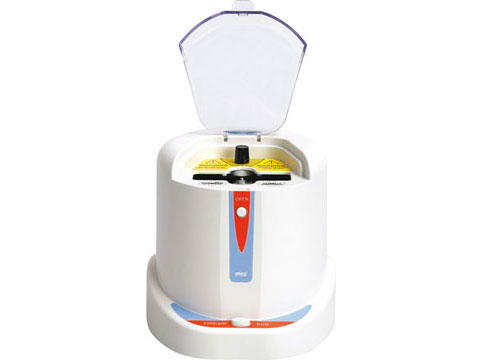
Plate centrifuges are dedicated laboratory instruments designed for fast, uniform, and safe centrifugation of laboratory plates, mainly PCR plates, ELISA plates, 96-well plates, 384-well plates, and PCR tube strips. Unlike standard centrifuges designed for individual tubes, a plate centrifuge is built to hold an entire plate securely, balance the samples, and collect liquid droplets at the bottom of the wells before or after an analytical process.
In molecular, biological, clinical, and industrial laboratories, working with plates has become a central part of routine testing procedures. When performing PCR, qPCR, ELISA, sample preparation, reagent mixing, or low-volume testing, even small droplets left on the well walls can affect reaction uniformity. Therefore, plate centrifuges provide an essential solution: they concentrate the liquid at the bottom of the plate, reduce material loss, improve repeatability, and help achieve more stable results.
What Is a Plate Centrifuge?
A plate centrifuge is a compact or benchtop centrifuge designed for centrifuging laboratory plates instead of individual tubes. The device applies centrifugal force to collect liquids, droplets, and condensation at the bottom of the wells. In many cases, the purpose is not deep component separation as in high-speed centrifuges, but rather a short, fast, and precise spin down.
This action is especially important when working with small sample volumes. In PCR plates, for example, volumes of only a few microliters may remain on the wall or lid. If the sample is not properly collected before the plate is inserted into the thermocycler, it may cause variation between wells, reduced reaction efficiency, or less uniform results.
Main Uses
Plate centrifuges are used in a wide range of applications in research, diagnostic, quality control, biotechnology, pharmaceutical, food, water, and environmental laboratories.
Centrifuging PCR Plates
One of the main uses is centrifuging PCR plates before and after running them in a thermocycler. Before the reaction, centrifugation helps bring all reagents to the bottom of the well. After the reaction, it can help collect condensation and droplets formed during temperature changes.
Centrifuges such as the MINI-PLATE are designed precisely for these types of operations, with compatibility for standard PCR plates, including skirted plates, non-skirted plates, and other common formats.
Working with ELISA Plates
In ELISA tests, uniform sample and reagent volume is extremely important. A plate centrifuge can help move liquid residues from the underside of the lid or from the well walls, especially after adding samples, antibodies, substrates, or washing solutions.
When a laboratory works with both ELISA plates and PCR plates, it is important to choose a model that supports both formats. MINI-PLATE-1, for example, is specified as suitable for PCR plates with or without a skirt, as well as ELISA plates.
Working with 96-Well and 384-Well Plates
96-well plates are very common in molecular and immunological testing. 384-well plates are mainly used in higher-throughput laboratories, where a large number of samples must be processed in especially small volumes. The smaller the volume, the more important it becomes to concentrate the sample at the bottom of the well.
According to the MINI-PLATE operating instructions, the device is intended for rapid spinning of samples in PCR plates and is mainly suitable for 96-well or 384-well plates with small volumes.
Sample Preparation Before Reading or Analysis
Before reading samples in a plate spectrophotometer, ELISA reader, fluorometer, or other analytical instrument, the sample should ideally be concentrated and uniform at the bottom of the well. Droplets on the wall or bubbles may affect optical measurement, cause light scattering, or create variation between wells.
A short centrifugation step can improve the sample condition before measurement, reduce noise, and contribute to higher accuracy.
Centrifuges for Gel Cards
In some laboratories, mainly in clinical fields and blood banking, Gel Cards are used. These are not standard PCR plates, so a dedicated instrument is required. MRC specifications include the CEN-ID24 model, which is designed for up to 24 Gel Cards, with defined parameters for card processing.
Key Advantages
Fast Collection of Droplets and Condensation
The first and most important advantage is the ability to quickly collect small droplets and condensation. When working with PCR, temperature changes often cause condensation on the lid or well walls. A short centrifugation step returns the liquid to the bottom of the well and helps maintain the reaction volume.
Improved Uniformity Between Samples
When all samples are concentrated in the same position inside the well, it is easier to achieve a uniform reaction. This is especially important in sensitive experiments, quantitative tests, and methods where even a small volume deviation can affect the result.
Time Savings in Laboratory Work
Instead of handling each tube separately, an entire plate can be centrifuged in one operation. For laboratories running dozens or hundreds of samples per day, this provides a significant saving in time and labor.
Suitable for Low-Volume Work
When working with microliter volumes, every droplet matters. Plate centrifuges allow more efficient use of valuable samples, sensitive reagents, and limited biological materials.
Compact Benchtop Design
Models such as the MINI-PLATE are designed to be compact and convenient for use on a laboratory bench. According to the specification, the MINI-PLATE is significantly smaller than many plate centrifuges, with a weight of approximately 3 kg and a convenient benchtop structure.